Call us today +971 - 56411 3575 or +971 - 58914 9282 | Email: info@vertexcompliance.com

What to Prepare Before an AML Compliance Review in Dubai

AML Compliance Review

You have an AML policy. Your staff have attended training. Customer documents are saved somewhere on the shared drive.

But could you pull up one customer’s file and explain why they were approved, how their risk was assessed, and what happened when a concern came up?

That’s a useful place to start when preparing for an AML compliance review in Dubai.

The work is about more than gathering documents. You need to connect your written procedures with what your team actually does, and show the records behind those decisions.

Here’s how to get ready without turning the exercise into a last-minute search through emails and folders.

First, Find out what Kind of Review you’re Preparing for

An internal health check, an independent audit, and a regulatory inspection can cover different grounds. Don’t assume they have the same purpose or document requirements.

Before collecting files, confirm:

  • Who is reviewing you: an internal team, an independent reviewer, or your supervisory authority.
  • What is covered: the whole program or specific areas, such as onboarding or screening.
  • Which period is covered: the dates and transactions under review.
  • What has been requested: the document list, sample requirements, and submission deadline.
  • Who will coordinate: one person to track requests and responses.

Dubai businesses do not all fall under the same supervisory rules. Use the requirements that apply to your activities and regulator. The checklist below is a practical preparation guide, not a universal inspection notice.

1. Get your Risk Assessment Ready

Your AML risk assessment should explain the risks your business faces and how you manage them.

For DNFBPs covered by the Ministry of Economy and Tourism’s guidance, the business risk assessment should be documented, supported by data, and kept current as the business and its risks change. DNFBPs are designated non-financial businesses and professions, a category that includes specified business activities outside the financial sector. [1]

Prepare:

  • Your current business risk assessment and methodology.
  • The information used to reach the ratings.
  • A record of changes since the previous assessment.
  • Evidence of the required management review or approval.
  • Actions assigned to address identified gaps.

Ask yourself: Does the assessment describe the business we operate today?

For example, if you started serving customers in a new market, check whether that change was considered. A recent date on the cover does not explain whether the assessment is still accurate.

2. Check Whether your Policies Match Daily Work

Read your AML/CFT procedures alongside a real customer journey.

Does the policy say that a manager approves higher-risk customers? Check where that approval is recorded. Does it describe a screening process? Ask an employee to demonstrate it.

Have these documents available where relevant:

  • The approved AML/CFT policy and operating procedures.
  • Customer acceptance and risk-rating procedures.
  • Customer due diligence and enhanced due diligence procedures.
  • Sanctions-screening and alert-handling procedures.
  • Internal escalation and suspicious reporting procedures.
  • Record-retention and access-control procedures.
  • Version history and approval records.

Also check that the program addresses proliferation financing, where required. AML, terrorist financing, and proliferation financing risks should not be treated as interchangeable.

If a procedure no longer matches the workflow, record the gap and assign a fix. Don’t quietly rewrite the history of how a process operated.

3. Test a Selection of Customer Files

A folder full of documents can still leave important questions unanswered.

Choose a small mix of files for your own preparation: different risk levels, customer types, and onboarding dates. This is a readiness exercise; it does not replace the reviewer’s sample selection.

For each file, check whether you can find:

  • Customer identification and verification evidence.
  • Ownership information and beneficial-owner checks, where applicable.
  • The purpose of the relationship and expected activity.
  • The risk rating and the reason behind it.
  • Relevant screening results and how alerts were resolved.
  • Extra checks, supporting evidence, and approvals for higher-risk situations.
  • Follow-up reviews or updates that were due.

Identification and verification requirements depend on the customer and risk involved. Use the rules that apply to your business rather than copying another firm’s document list. [2]

Try this: Open a corporate customer file. Could someone unfamiliar with the customer understand who ultimately owns or controls it? If they need three phone calls to find out, the file may need work.

4. Gather Evidence of Screening and Monitoring

“We use screening software” explains which tool you bought. It does not explain how your team handles its results.

For the controls relevant to your business, prepare evidence showing:

  • What was checked and when.
  • Which alerts were reviewed.
  • Who reviewed them.
  • The supporting information considered.
  • The decision and any follow-up action.

Prepare examples of transaction or activity reviews too, where relevant. Include the explanation for unusual activity and how the matter was resolved or escalated.

The Central Bank’s record-keeping guidance for licensed financial institutions includes screening, monitoring, investigation, and analysis records. That guidance is specific to those institutions; other businesses should check their own requirements. [3]

5. Review Escalation and Reporting Records carefully

Your team should know where to take a concern. The designated reviewer should be able to explain what happened next.

Check that you can trace an internal concern from receipt through assessment to the decision taken. Keep the supporting evidence available to authorized reviewers.

A decision not to file a suspicious transaction or activity report should have a clear basis. Equally, having no reports on file does not, on its own, prove that a reporting process works. Reporting obligations depend on the applicable suspicion threshold. [4]

Handle these records with care:

  • Restrict access to people authorized to see them.
  • Use an appropriate secure route when responding to review requests.
  • Follow applicable confidentiality and anti-tipping-off requirements.
  • Don’t move sensitive reports into a widely accessible preparation folder.

6. Prepare Training Records—and Speak to your Staff

Attendance matters, but it is only part of the picture.

Gather your training plan, materials, attendance records, assessment results where used, and follow-up for missed sessions. Central Bank guidance for licensed financial institutions specifically addresses these types of evidence. [5]

Then ask staff a few practical questions:

  • What would you do if a customer refused to explain a payment?
  • Who would you contact about an unresolved screening alert?
  • Where would you record a concern?
  • What information should you avoid discussing with the customer?

Use their answers to find training gaps. Don’t coach staff to claim they follow a process they don’t understand.

7. Show what Happened to Previous Findings

If an earlier review identified a weakness, be ready to explain its current status.

A simple action tracker is more useful than a folder labelled “completed.”

FindingAction takenOwnerEvidenceStatus
Risk ratings lacked explanationsAdded guidance and reviewed affected filesCompliance leadUpdated files and review notesAwaiting validation
Some staff missed trainingAssigned catch-up sessionsTraining coordinatorAttendance and assessment recordsComplete
Review reminders were not workingCorrected the workflow and tested remindersOperations leadTest results and follow-up checksIn progress

These are illustrative examples, not findings about a particular business.

Be clear about work still in progress. Record the next step and a realistic deadline. Marking an issue closed before checking the fix can leave the original problem unresolved.

Your AML Compliance Review Document Checklist

Use this table as an index. Adjust it to the actual request and your applicable obligations.

AreaWhat to have ready
Business profileLicense, activities, ownership structure, and relevant organizational chart
GovernanceCompliance responsibilities, reporting lines, and management oversight records
Risk assessmentCurrent assessment, methodology, supporting information, and approvals
PoliciesApproved procedures, version history, and evidence of implementation
Customer filesDue diligence records, risk decisions, approvals, and updates
Screening and monitoringReview logs, alert decisions, supporting evidence, and follow-up
ReportingRestricted-access escalation and reporting records, where applicable
TrainingMaterials, attendance, assessments where used, and missed-session follow-up
Previous findingsAction tracker, completion evidence, and validation results

Three Mistakes that make Preparation Harder

Collecting Everything without an Index

Hundreds of files are difficult to navigate. Create an index showing the request, file location, owner, and submission status. Keep sensitive material under appropriate access controls.

Updating Documents without Checking the Process

A revised policy does not show that the change has reached staff. Check whether forms, workflows, and training need updating too.

Trying to Make every File Look Perfect

Never backdate approvals or create records that suggest a check happened when it did not. Keep a factual record of the gap, what you have done now, and what remains outstanding.

Before the Review Begins, Run one Walkthrough

Take a customer relationship from start to finish:

  1. Find the onboarding records.
  2. Explain the risk rating.
  3. Locate relevant screening and review decisions.
  4. Show how concerns were handled.
  5. Confirm that an authorized person can retrieve the evidence.

Notice where the walkthrough slows down. Those sticking points give you a practical list of things to address before the review.

Need Help Getting Ready?

If your records are scattered or you’re unsure whether your procedures match daily work, start with a focused gap review.

Contact Vertex Compliance to discuss AML/CFT compliance services in Dubai and the preparation support your business needs.

AML Compliance in Dubai: How to Build an Inspection Evidence File

AML compliance in Dubai:

Most businesses do not struggle to produce an AML policy. The difficulty starts when they need to explain what happened with a particular customer.

Why was the customer rated low risk? Who reviewed the screening alert? Was the ownership information checked before the relationship began?

The answers may exist, but finding them can involve several folders, an old email chain and a call to the employee who handled onboarding.

An inspection evidence file brings those answers together. For businesses managing AML compliance in Dubai, it provides a practical way to demonstrate how procedures work in everyday transactions.

What Is an Inspection Evidence File?

An inspection evidence file is an organised set of records supporting your AML programme. It connects policies with the customer checks, assessments, approvals and follow-up work carried out under them.

It does not need to be one large PDF. A secure digital folder structure can work, provided records are controlled, accessible and connected.

The important point is whether someone unfamiliar with the work can understand it. A passport establishes one part of the customer’s identity. It does not explain the customer’s risk rating or why a particular payment was accepted.

Your evidence should make those decisions understandable.

Check Your Regulatory Position First

Before collecting documents, confirm which authority supervises your business and what it expects.

The Ministry of Economy and Tourism supervises specified designated non-financial businesses and professions, or DNFBPs, within its mainland and commercial free zone remit. Relevant persons within the DIFC are subject to applicable DFSA AML requirements.

The federal framework includes Federal Decree-Law No. 10 of 2025 and Cabinet Resolution No. 134 of 2025. Sector requirements and supervisory guidance also need consideration.

Use the sections below as a filing approach, then adjust them to your obligations and inspection scope.

1. Keep Policies and Responsibilities Together

Start with approved AML procedures, previous versions, the compliance officer’s appointment and internal reporting arrangements.

Earlier versions matter. A customer onboarded two years ago may have been assessed under a different procedure. Keeping that version helps explain the checks required at the time.

Include compliance reports and relevant management decisions. If management agreed to address overdue customer reviews, retain the deadline, assigned responsibility and subsequent progress.

A note saying “compliance discussed” offers little explanation. Someone reading it later should be able to understand the problem and the response.

2. Explain the Risks Behind Your Procedures

Your business risk assessment should reflect how your business operates.

A property brokerage dealing with corporate buyers will have different concerns from a jewellery retailer serving mainly individual customers. The assessment should explain those differences through relevant customer, geographic, service, transaction and delivery-channel risks.

Keep the methodology, supporting information, findings and approval together.

Then show how the assessment affected your controls. If complex ownership was identified as a concern, where does your onboarding process address it?

This connection matters more than an isolated risk score. Review the assessment when business circumstances change, rather than waiting automatically for its scheduled review.

3. Make Customer Files Tell the Whole Story

Customer records often become fragmented because several people contribute to them. Sales collects documents, operations enters information and compliance reviews the risk.

Use one customer reference to connect their work.

Depending on applicable requirements and circumstances, keep:

  • Identity and verification records.
  • Company documents and ownership information.
  • Beneficial ownership checks.
  • The purpose of the relationship.
  • Customer risk assessments and supporting reasons.
  • Additional enquiries and approvals, where required.
  • Later reviews and relevant correspondence.

For a corporate property buyer, the trade licence alone may leave ownership questions unanswered. Preserve the documents and analysis used to establish who ultimately owns or controls the business.

Where source-of-funds or source-of-wealth checks are required, retain the evidence and explain how it was assessed.

Businesses using managed KYC services should also agree where records will be held and how their team can access them.

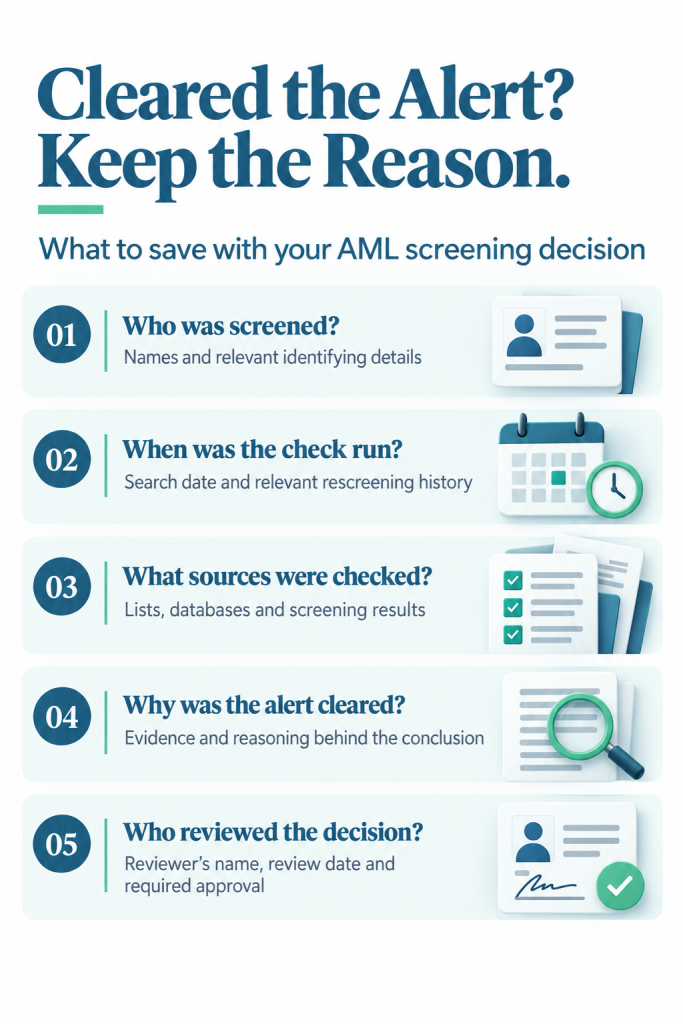
4. Record Why Screening Alerts Were Cleared

A screening result becomes difficult to interpret when it lacks a date, search details or reviewer’s explanation.

Keep the names and relevant identifiers searched, sources used, results, review date and conclusion.

Sanctions screening, politically exposed person checks and adverse media reviews should remain distinguishable because they raise different questions.

Suppose a name produces a potential match. If identifying details establish that it concerns someone else, record those details. “False positive” is a conclusion; the file also needs the reasoning.

Check that historical results remain available if you change screening providers. Losing access to an old platform should not leave earlier decisions unsupported.

5. Follow Unusual Activity Through to a Decision

Consider a buyer who asks an unrelated company to pay on its behalf.

The arrangement raises questions, but the file needs more than a note saying “third-party payment reviewed.” Keep the enquiry, information received, assessment and resulting action together.

Monitoring records should make it possible to follow a concern from discovery through escalation and resolution.

Where reporting is required, retain relevant goAML submission evidence, supporting analysis and follow-up communications.

Restrict access to suspicious reporting material. Confidentiality and tipping-off obligations need to be respected, so these records should not sit in customer folders available to everyone.

6. Show What Employees Learned

Training evidence should go beyond a presentation and attendance list.

Keep training dates, materials, attendance, proportionate knowledge checks and follow-up records together. The examples should reflect employees’ actual responsibilities.

An onboarding employee may need practice working through an incomplete ownership chart. Someone handling payments needs to recognise arrangements that require further enquiry.

If an employee misses training or struggles with an assessment, record what happens next.

This gives the business a more useful picture of staff understanding than attendance figures alone.

7. Keep Track of Problems Until They Are Resolved

Compliance reviews will sometimes find missing records or inconsistent decisions. Your file should show how the business responds.

An AML gap assessment can help identify areas requiring attention before inspection preparation begins.

Record each finding, its significance, the person responsible, the deadline and the action taken.

Check whether the fix worked. Uploading missing documents may repair existing files, while reviewing newer files helps establish whether the underlying process improved.

Never backdate a check or create an approval that did not happen. Record the actual discovery date and corrective work.

8. Make Records Easy to Retrieve

Create an index showing where records are held, who maintains them and who has access.

Consistent filenames, customer references and version histories make retrieval easier. Avoid overwriting earlier evidence when updating a record.

Retention periods must follow applicable requirements. DFSA AML Rule 14.4.1, for example, specifies at least six years for listed records, calculated from the latest relevant event identified in that rule. That should not be treated as a universal period for every Dubai business.

Consider investigations, legal holds and longer applicable preservation obligations before deleting records.

Give the File a Trial Run

Choose three customer files with different risk profiles. Ask a colleague who did not prepare them to trace the checks, approvals and subsequent reviews.

Notice where explanations are missing or documents cannot be opened. Give each problem an owner and deadline.

This exercise exposes filing problems before they become difficult inspection questions.

Need help reviewing your records? Discuss your preparation needs with Vertex Compliance through its AML periodic inspection service.

Frequently Asked Questions

1. What belongs in an AML inspection evidence file?

Include records supporting governance, risk assessments, customer checks, screening, monitoring, training and corrective actions. Adjust the contents to your business activity, applicable requirements and the documents requested for inspection.

2. Is an AML policy enough for an inspection?

No. A policy explains what employees should do. Completed checks, assessments, approvals and follow-up records help demonstrate how those procedures were applied to actual customers and transactions.

3. Can the evidence file be kept electronically?

Yes, subject to applicable requirements. Records should remain secure, readable and accessible, with suitable permissions and backups. Test whether authorised employees can retrieve them when needed.

4. What should we do about missing evidence?

Record the gap, assess its significance and assign corrective action. Obtain missing information where possible and consider escalation. Never imply that a check occurred earlier than it actually did.

5. When should the file be updated?

Add evidence as work happens. Revisit the structure after material business or regulatory changes, and periodically check whether another employee can locate the records and understand the decisions.

AML Compliance Services in the UAE: Top 14 Questions Answered

AML Compliance Services

Your bank has asked for an AML policy. A customer’s ownership documents are incomplete. Or you’ve been told your business needs to register on goAML, but nobody has explained what comes after registration.

Where do you start?

AML compliance services can help you work through these questions and put the right procedures in place. Before choosing a provider, though, it helps to know what you need and what you should expect for your money.

Here are answers to some common questions about AML compliance services in the UAE.

1. What are AML Compliance Services?

AML stands for anti-money laundering. AML compliance services help businesses understand and meet their obligations to prevent their operations from being used for financial crime.

The work might involve assessing your risks, preparing procedures, reviewing customer files, setting up screening or training employees. Some businesses need help getting started. Others already have a compliance team and need support with a particular problem.

Although “AML” is often used as shorthand, the UAE framework also addresses terrorist financing and proliferation financing.

2. Does My Business Need AML Compliance in the UAE?

That depends on your activities and the rules that apply to them.

Banks and other regulated financial businesses have AML obligations. So do certain non-financial businesses and professions, known as DNFBPs. These include real estate agents and brokers, dealers in precious metals and stones, independent accountants and auditors, and trust and company service providers within the relevant scope. Certain legal professionals also fall within the framework.

If you’re unsure, check your actual business activities against the applicable requirements. Your company’s size or the wording of its trade name will not answer the question on its own.

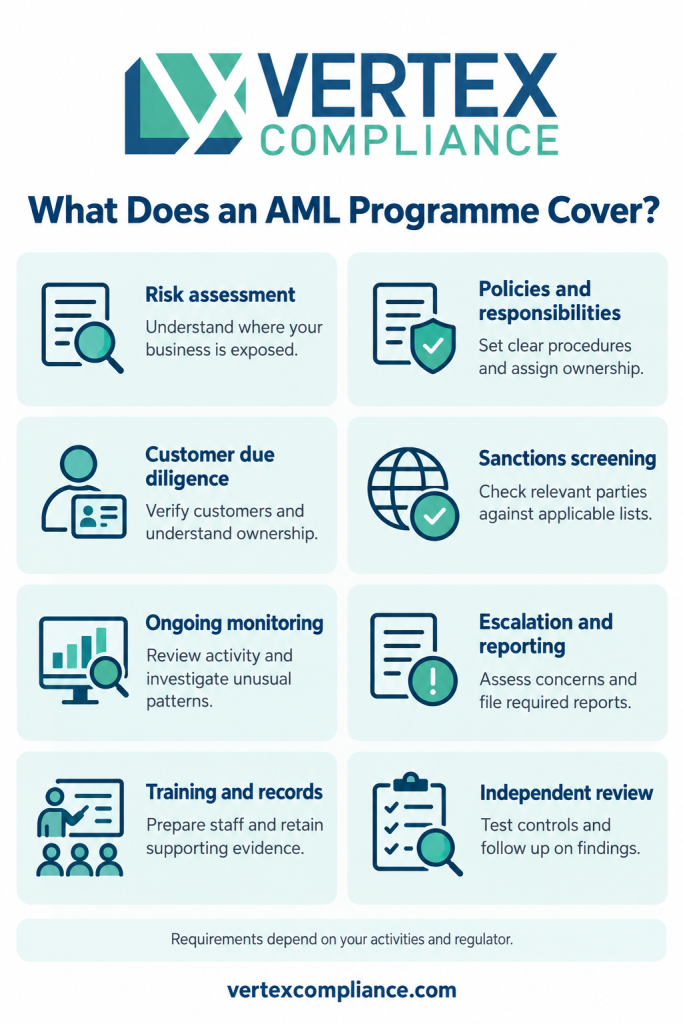
3. What should an AML Programme Cover?

Main areas of an AML programme, including risk assessment, customer checks, sanctions screening, monitoring, reporting, training, records and independent review

4. What is the Difference between KYC and AML Compliance?

KYC means “Know Your Customer.” It forms part of AML compliance, but the two terms do not mean the same thing.

KYCAML compliance
What does it involve?Identifying customers, verifying their details and understanding who owns or controls a customer company.Managing the wider risk of the business being used for money laundering and related financial crime.
What does the work look like?Collecting and checking identity documents, ownership information and details about the business relationship.Assessing risks, applying customer checks, screening, monitoring activity, escalating concerns, reporting and training staff.
When does it happen?At onboarding and when information needs to be updated or reviewed.Throughout the business relationship and across relevant operations.

Collecting a passport copy is a starting point. It does not, by itself, tell you whether a customer’s activity makes sense.

5. Is an AML Policy enough to Make my Business Compliant?

No. A policy explains what your business is supposed to do. You also need to show that people follow it.

Take a policy that requires higher-risk customers to receive additional checks and approval. If the files contain neither, the written procedure has not solved the problem.

When you hire a provider, ask how they will help your team put the procedures into practice. You should know who carries out each check, who reviews exceptions and where the evidence is kept.

6. Do we Need to Register on goAML?

If your business falls within the DNFBP requirements, goAML registration is mandatory. The UAE Financial Intelligence Unit uses the platform to receive suspicious transaction reports, suspicious activity reports and other applicable reports.

Registration gives you access to the system. It does not replace the work needed to identify concerns, assess them and submit the appropriate report.

Make sure someone is responsible for maintaining access and understands how reporting works.

7. Can we Outsource AML Compliance?

External specialists can support parts of your AML work. However, what you can outsource—and whether an external compliance officer or MLRO arrangement is permitted—depends on your regulator and the applicable requirements.

Before agreeing to an arrangement, clarify who will handle customer reviews, alerts, reporting, management updates and regulatory correspondence. Also check any appointment or approval requirements.

Your business and its management retain their responsibilities. Hiring a consultant does not transfer those responsibilities to the consultant.

8. How Much do AML Compliance Services Cost in the UAE?

There is no useful single price for every business.

A firm needing an initial assessment and a few procedures will require a different amount of work from a business with several branches, complex ownership structures and a large number of screening alerts.

Ask for a quote that explains:

  • The work included and the deliverables you will receive
  • Whether support is a one-off project or an ongoing service
  • Any separate software or screening charges
  • Whether training and follow-up are included
  • How additional work will be charged

A low quote is not necessarily good value if your team is left doing most of the work you thought you had paid for.

9. How Long Does it Take to Set Up AML Compliance?

The answer depends on what is already in place.

Before giving you a timeline, a provider should understand your business, review the available documents and identify the main gaps. Preparing procedures is one task. Reviewing existing customer files, introducing systems and training employees are separate tasks that also take time.

Ask for milestones rather than a vague completion date. What will be delivered first? What does your team need to provide? How will you know the procedures are ready to use?

10. Do we Need AML Software?

That depends on your workload, risks and regulatory requirements.

Software can help with screening, customer records, risk ratings and transaction monitoring. But someone still needs to check the results, investigate alerts and record decisions.

Before buying a system, identify the problem you need it to solve. Is your team struggling with screening volumes? Missing review dates? Inconsistent customer records?

Those answers will help you choose something useful instead of paying for features nobody uses.

11. What Happens if we Suspect a Customer or Transaction?

Employees should raise the concern through the business’s internal reporting process. The designated compliance officer or MLRO can then assess it and determine the reporting or other action required.

You do not need to prove that a crime has occurred before a reporting obligation can arise. UAE guidance refers to reasonable grounds for suspicion, including concerns involving attempted transactions.

Staff should also understand confidentiality and tipping-off restrictions. They should not tell a customer that a suspicious activity report is being considered or filed.

12. What Documents will an AML Consultant Need?

Expect requests for your trade licence, ownership details, existing policies, risk assessments and information about your customers and services.

Depending on the assignment, the consultant may also need customer files, screening records, training records, management reports and previous findings.

You should receive a document list linked to the agreed work. If you are being asked for sensitive customer information, clarify how it will be transferred, who can access it and how it will be protected.

13. How do I Choose an AML Compliance Provider in the UAE?

Ask them to explain how they would approach your business.

A useful conversation should go beyond a list of documents they can prepare. They should ask about your customers, services, locations, existing procedures and the problems your team faces.

Before signing, ask:

  • Have you worked with businesses in our sector?
  • What will you review before recommending changes?
  • Will you help our employees use the procedures?
  • What support is available after delivery?
  • How will we track work and unresolved issues?

Be cautious of anyone promising guaranteed compliance or a guaranteed inspection outcome. A provider can help you prepare and improve your controls; it cannot make that promise.

14. Can Vertex Compliance Help if we already have an AML Programme?

Yes. You may already have policies, screening tools and an internal team but need help with a specific area.

That could mean reviewing customer due diligence, assessing risks, training staff or examining weaknesses identified during a previous review. Vertex Compliance offers AML/CFT compliance, advisory, software and training services, with the work agreed around your needs.

You do not have to begin by replacing everything. Start with the concern you want to resolve and establish what needs attention.

Need help with AML compliance in the UAE? Speak to the Vertex Compliance team.

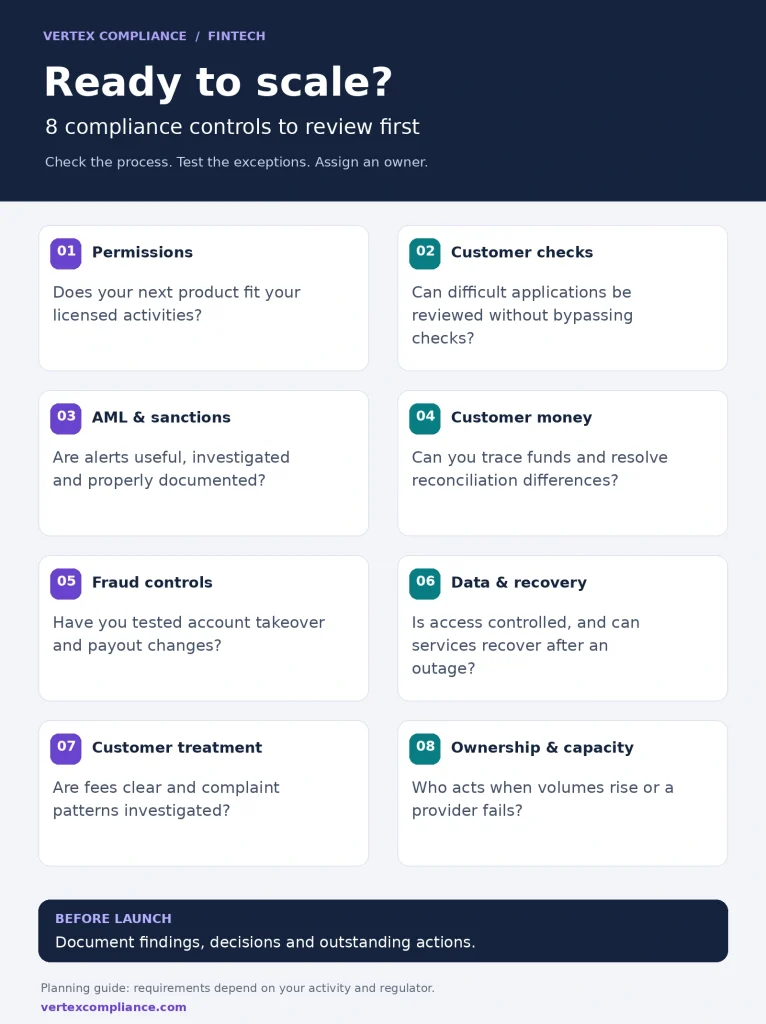
Fintech Compliance Solutions: 8 Controls to Review Before Scaling

Fintech Compliance Solutions: 8 Controls to Review Before Scaling

Your payment app is gaining customers. A distribution partner wants to bring in more users. The product team has a feature ready, and investors are asking when you will enter the next market.

Then someone asks whether the onboarding process can handle twice as many applications.

Nobody has tested it.

Growth has a way of exposing problems that were easier to manage with fewer customers. Manual checks become backlogs. Payment differences take longer to investigate. Employees start making exceptions because the existing process cannot keep up.

Fintech compliance solutions should help you identify these weaknesses before expansion adds pressure. The starting point is a practical review of how your business operates today and what will change when it grows.

Controls to Review before Scaling

A digital wallet, payment gateway and lending platform do not have identical compliance needs. Your controls should reflect your activities, customers, payment flows and regulatory obligations.

For a UAE fintech, begin by confirming the requirements that apply to its licence and regulator. Then review customer onboarding, financial crime controls, customer money, technology and consumer protection.

Bring product, operations, finance and compliance into the discussion. Each team sees different problems. A customer complaint might reveal a settlement issue that never appears in a compliance report.

Use the following checks to guide that conversation.

1. Confirm Your Permissions Before Expanding

A new feature can change your regulatory position.

Perhaps your platform currently connects buyers and sellers but will soon hold customer balances. Or you process domestic payments and want to introduce overseas transfers.

Have the proposed activity assessed before committing to a launch date. The CBUAE’s retail payment framework distinguishes between different services, so calling a product a “payments app” does not establish which permissions it needs. rulebook.centralbank.ae

Write down who receives funds, who holds them and who executes transactions. Include every partner involved.

Do not assume a partner’s licence automatically permits your own activities. Get clarity on each business’s responsibilities and any approvals required for the proposed arrangement.

2. Review KYC and Customer Onboarding

Most onboarding demonstrations show a customer with clear documents and straightforward information.

Actual applications are messier.

Names differ between records. An identity check fails. A business customer has several ownership layers. Someone submits another application after being rejected.

Follow a sample of difficult cases through your Know Your Customer process. Can reviewers see why a check failed? Can they request more information? Is the reason for approving an exception recorded?

Check what incomplete applications allow customers to do. Any access before outstanding checks are resolved needs to be permitted and appropriately restricted.

Also measure the queue. If applications already wait several days for manual review, a marketing campaign could turn a manageable delay into a serious backlog.

3. Review AML Monitoring and Sanctions Screening

A monitoring rule can be switched on without producing useful results.

A rule focused on individual large transfers, for example, may miss suspicious activity involving several smaller payments. Another might produce so many alerts that investigators struggle to identify urgent cases.

Review AML monitoring against your products, customer groups and payment routes. Ask whether the information investigators receive is sufficient to understand an alert.

Sanctions screening needs attention when relevant lists, customer details or connected parties change.

Check what happens after a potential match. Who investigates? Who can stop activity? What evidence supports the decision?

The CBUAE’s payments guidance discusses financial crime risks associated with payment products and services. Use those risks to challenge whether your controls fit your actual business. rulebook.centralbank.ae

4. Trace Customer Funds and Reconciliations

Pick a payment and follow it from receipt to settlement.

Then try a refund, a failed transaction and a payment received near the daily reporting cut-off. Can finance and operations explain where the money is at each stage?

Where safeguarding requirements apply, check that your arrangements meet the rules for your activity.

Reconciliation deserves particular attention. Who investigates differences between customer balances and underlying records? How are unresolved amounts tracked? Who takes over when the usual employee is absent?

Avoid accepting “the system handles it” as a complete answer. Ask someone to demonstrate the process and explain a recent mismatch.

Higher transaction volumes will make unexplained differences harder to investigate.

5. Test Your Fintech Fraud Controls

Fraud prevention needs its own review alongside AML compliance.

Consider account takeover, stolen credentials, fake merchants, refund abuse and changes to payout details.

Test realistic scenarios in a controlled environment. What happens when a customer resets a password and immediately changes their bank account? Can repeated failed payment attempts continue without review?

Check employee permissions too. Support staff need enough access to resolve problems, but sensitive actions should have appropriate restrictions and records.

Review legitimate customers affected by fraud controls. If people are repeatedly blocked without a clear reason, complaints will rise—and staff may begin finding ways around the process.

Investigate both missed fraud and unnecessary restrictions.

6. Review Data Security and Business Continuity

Start with access to customer information.

Who can view identity documents, payment records and support conversations? Include contractors, service providers and employees who have changed roles.

Check whether access is removed promptly and whether sensitive actions can be traced.

Then test a service disruption. If your screening provider becomes unavailable, does onboarding pause, queue applications or follow an approved contingency process?

Someone needs authority to choose the response.

Ask for evidence that backups can be restored. A successful backup notification does not prove your team can recover the service and its records.

Check that recovery plans reflect dependencies between systems, rather than treating each supplier separately.

7. Check Consumer Protection and Complaints

Read the customer journey on a phone.

Are fees visible before confirmation? Are payment limits understandable? Does the refund explanation match what happens in practice?

Pay attention to messages shown when something goes wrong. “Transaction unsuccessful” gives customers little help if money has left their account.

Complaints can expose problems before management reports do. Several customers describing delayed refunds may point to a broken handoff between support and finance.

Assign someone to investigate recurring issues and report findings to product and operations.

Customers reporting suspected fraud also need a clear route to help. They should not have to contact several departments while an account remains exposed.

8. Assign Owners and Check Team Capacity

A control needs someone who can act when it identifies a problem.

Name the owner, the person authorised to approve changes and the backup contact.

Then look at workload. If alerts double, how many additional reviews can your team realistically complete? If a provider misses a deadline, who follows up?

Before launch, agree which findings must be resolved and which can be managed through documented restrictions.

Track overdue actions, unresolved cases and repeated errors. These show where work is getting stuck.

A policy update may be complete while the process it describes remains broken. Check what employees actually do before marking an issue closed.

Review Your Fintech Compliance Solutions with Vertex Compliance

Before scaling, your team should be able to explain its main risks, demonstrate its controls and identify who handles exceptions.

If those answers are unclear, resolve the gaps while changes are still manageable. Waiting until customer numbers rise usually means more records to review and more people affected.

Vertex Compliance’s fintech compliance solutions draw on its advisory services for fintech setup, policy drafting, anti-fraud frameworks, data protection and consumer protection. 

Discuss Your Fintech Compliance Needs to identify support relevant to your UAE business, its activities and expansion plans.

FAQs

1. When should a fintech review its compliance controls?

Before launching a product, entering a market or significantly increasing transaction capacity. Repeated complaints, incidents and growing review backlogs are also reasons to reassess existing controls.

2. Does compliance software make a fintech compliant?

Software supports checks and monitoring. Your team still needs to configure it correctly, investigate exceptions and assess whether its results remain useful as products and customers change.

3. Which compliance controls should we review first?

Confirm that proposed activities fit your permissions. Then prioritise weaknesses affecting customer funds, financial crime prevention and service continuity, based on the risks of your planned expansion.

4. Can a fintech outsource compliance tasks?

Some tasks may be outsourced where permitted. Check applicable conditions, retain oversight and agree how the provider will escalate concerns, protect information and demonstrate completed work.

5. What records should a compliance review produce?

Keep the scope, test results, findings and corrective actions. Record decisions about outstanding risks, who approved them, any temporary restrictions and when those decisions must be reviewed.

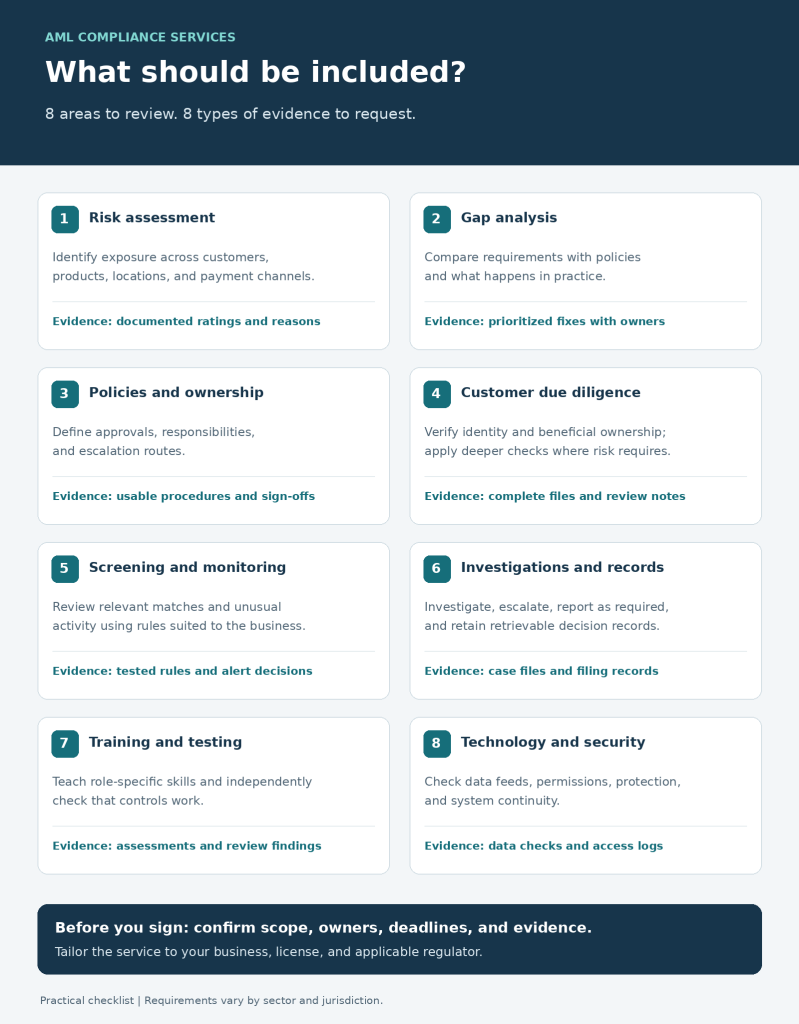
What Should AML Compliance Services Include? A Guide for Compliance Teams

AML Compliance Services

An AML service proposal can look thorough and still leave you with unanswered questions.

It mentions risk assessments, customer checks, monitoring, and training. Everything appears to be there. Then a difficult customer file arrives, and you discover that reviewing complex ownership sits outside the agreement. The provider can raise an alert, but your team must investigate it. Reporting support means preparing notes, not submitting a report.

These details matter when you’re choosing AML compliance services. You need to know how the arrangement will work on an ordinary Tuesday, with a growing case queue and someone waiting for approval.

Before signing, work through the tasks your team needs help with. The following areas are a good place to start.

First, Be Clear About What You Need

AML compliance services help businesses identify money laundering risks, put controls in place, and carry out applicable compliance duties. The work can range from reviewing a few overdue customer files to helping rebuild an entire program.

Your starting point makes a difference.

An established business may have workable policies but too few people to investigate alerts. A newer firm may need help deciding which checks belong in its onboarding process. Another team might be preparing for an inspection and struggling to retrieve supporting records.

Tell the provider where work gets stuck. Be specific about the backlog, the recurring questions, and the decisions staff are unsure about. That conversation is more useful than choosing a package because it has the longest list of features.

A Financial Crime Risk Assessment With Reasons Behind It

A financial crime risk assessment helps you understand where exposure comes from and whether your controls are doing enough.

It usually examines customers, ownership structures, products, countries, transaction activity, and the ways people access your services. Relevant terrorist financing, proliferation financing, and sanctions risks also need consideration.

The assessment needs to reflect your business as it operates today.

Perhaps you’ve started accepting customers from another market. Perhaps a payment service now allows transfers that weren’t possible a year ago. Those changes can make an older assessment incomplete.

Pay attention to the reasoning behind the ratings. If a customer category is marked high risk, your team needs to understand why. Otherwise, it’s difficult to decide what additional checks would help.

You should receive a documented method, supporting evidence, and a clear account of the risks that remain after controls.

An AML Gap Analysis You Can Work From

An AML gap analysis checks whether your arrangements meet applicable requirements and whether the controls work as intended.

Reading the manual is part of that job. Looking at actual files is another.

For instance, your policy may require staff to identify beneficial owners. A sample of customer records might reveal that they’ve collected company certificates without establishing who ultimately owns the business.

That finding gives you something concrete to address.

The report needs to explain what went wrong, where the evidence came from, and which requirement or control is affected. It also needs a practical recommendation.

“Improve due diligence” leaves too much open. Identifying the missing check, assigning an owner, and setting a completion date makes the work manageable.

Agree on how fixes will be tested. A task marked complete may still leave the underlying problem unresolved.

Customer Checks That Go Beyond Collecting Documents

A folder full of documents doesn’t necessarily mean you understand the customer.

Take a company owned through several other companies. You may have registration papers for each entity and still be unable to explain who ultimately controls it.

Customer due diligence support needs to deal with these situations. Alongside identity verification, it may include beneficial ownership checks, customer risk ratings, understanding the relationship’s purpose, and keeping information current.

Higher-risk cases may need enhanced due diligence. Depending on the circumstances and applicable rules, that can involve further information about source of funds or source of wealth.

Find out what happens when documents conflict or information cannot be verified. Who investigates? Who approves the next step?

Those decisions shouldn’t depend on which colleague happens to be available that day.

Screening That Helps Staff Reach a Decision

Anyone who has reviewed screening matches knows how quickly a common name can create extra work.

The system flags a possible match. The available details are limited. An analyst has to decide whether the result relates to the customer or someone else.

The service needs a consistent review process for those cases.

Screening may address applicable sanctions lists, politically exposed persons, and relevant adverse media. Each calls for an appropriate assessment. A politically exposed person is not automatically a prohibited customer, and a news mention needs to be checked for relevance and credibility.

Clarify how lists are updated and when existing customers are screened again.

Look at the review notes too. Someone picking up the file later should be able to follow the conclusion without starting from scratch.

Transaction Monitoring Suited to Your Customers

A transaction pattern only makes sense when you know something about the account.

Frequent small payments might be expected for a merchant. The same activity could be unusual for a customer whose account normally receives one monthly payment.

Monitoring needs to account for that context.

Check which scenarios the provider uses, what data feeds them, and how thresholds are tested. Rules borrowed from a different business may create unnecessary alerts or miss activity your team needs to examine.

Then follow an alert through the process. Who reviews it? How are urgent cases identified? What happens when the queue builds up?

Lower alert numbers may be welcome, but they don’t establish that monitoring has improved. Testing needs to show whether relevant activity still gets detected and reviewed.

Clear Investigation and Reporting Responsibilities

An analyst reviewing unusual activity needs access to the full picture.

That might include customer documents, ownership information, transaction history, previous alerts, and explanations already obtained. When records are scattered across teams, a straightforward review can become a series of follow-up emails.

Set out who gathers the evidence and who assesses it. Specify who decides whether a suspicious transaction or activity report is required.

Reporting support needs careful definition. Preparing a case summary, reviewing a draft, and submitting a filing are different tasks.

The arrangement also needs to address applicable deadlines, confidentiality, and restrictions on tipping off customers.

For closed cases, keep the reasoning. A note saying “reviewed—no concern” won’t help much when someone asks what was examined and why the case was closed.

Procedures Staff Can Use, With Training to Match

A procedure becomes useful when it answers the question in front of the employee.

What if the ownership information is inconsistent? What if an urgent screening match arrives while the compliance officer is away? Who can approve a higher-risk relationship?

Staff need clear steps and named responsibilities.

Training should use examples drawn from the work each team handles. Onboarding employees need practice spotting missing information. Investigators need to weigh evidence. Managers need to understand unresolved risks and resource needs.

Attendance records matter, but check understanding as well.

Independent testing then looks at what happens in practice. It may involve sampling customer files, tracing alerts, reviewing reporting decisions, and testing corrective actions. Where one provider designs and reviews the program, examine how independence and conflicts are managed.

Don’t Overlook AML Software Security Risks

AML systems contain information you would not want exposed: identity documents, transaction records, ownership details, and investigation notes.

AML software security risks therefore belong in the service discussion from the beginning.

Review access permissions, encryption, audit logs, backups, incident response, subcontractors, and data location. Check how access is removed when someone leaves and what happens to your information when the contract ends.

Also check whether the system receives complete, accurate data. A missing transaction feed can weaken monitoring even when the software appears to be running normally.

For digital banking compliance, follow a customer through remote onboarding, screening, monitoring, and reporting. Fintech compliance solutions need to fit the product’s payment routes and speed, with clear arrangements for cases requiring human judgment.

Use this checklist to compare service proposals and identify missing deliverables.

What UAE and Dubai Businesses Need to Check

When comparing AML compliance services UAE providers offer, establish which framework applies to your business activity, license, and supervisory authority.

The UAE introduced Federal Decree-Law No. 10 of 2025 and its executive regulations. The DFSA’s updated AML and Glossary Modules took effect on March 2, 2026. The proposed work needs to reflect the requirements applicable to your firm. www.dfsa.ae

For AML compliance Dubai businesses require, check the provider’s experience with your regulator. Being based in Dubai does not automatically put a business under the DFSA; its financial services jurisdiction is the DIFC. www.dfsa.ae

Request a written connection between those requirements and the services included.

How Vertex Compliance Can Support Your Team

You may need help clearing overdue customer reviews. Or your team may be preparing for an AML inspection while keeping up with daily work.

At Vertex Compliance, our compliance outsourcing services support the areas where you need extra capacity. That includes KYC reviews, regulatory data preparation, inspection readiness, and ongoing compliance work. You can get help with specific tasks without outsourcing your entire compliance function.

Start with the issue taking up too much of your team’s time. We’ll discuss the support needed around your business, regulator, and existing resources.

Frequently Asked Questions

1. What should AML compliance services include?

You’ll usually need help with risk assessments, customer checks, screening, transaction monitoring, reporting, training, and independent testing. The details matter, though. Will the provider investigate alerts or just send them to your team? Will they review difficult ownership cases? Get those answers before agreeing to the scope.

2. What is the difference between an AML gap analysis and a financial crime risk assessment?

A financial crime risk assessment looks at where your business is exposed. An AML gap analysis checks what’s missing or isn’t working in your program. Say you deal with companies that have complicated ownership structures. The risk assessment examines that exposure; the gap analysis checks whether your team is actually identifying the owners properly.

3. How should businesses choose an AML compliance services provider in the UAE?

Find out whether they understand your industry and the regulator you report to. Then bring up a problem you’re dealing with. How would they resolve an incomplete customer file, for example? Their answer will tell you more than a sales presentation. Check a sample deliverable, the fees, and any exclusions before signing.

4. Can compliance outsourcing services replace an internal compliance team?

Outsourcing can take work off your team’s plate, but you still need someone in the business to oversee it. Who will approve a difficult case or follow up when work is overdue? Decide that early. You’ll also need to check whether your regulator allows the particular role or task to be outsourced.

5. What AML software security risks should compliance teams review?

Check who has access to customer files and whether they need that access. Can they download sensitive records? Is their access removed when they leave? Ask about outages, data breaches, and recovery too. Don’t overlook missing payment feeds—a system can look fine on screen while transactions never reach its monitoring rules.

AML Compliance Services in the UAE: How to Choose the Right Support

AML Compliance Services in the UAE: How to Choose the Right Support

Suppose your business has an AML review coming up. You pull a few customer files to check whether everything is in order. One has an expired document. Another has a risk rating with no explanation. A third is missing an approval.

You now have two jobs: find out how far the problem goes and decide who will fix it.

This is often where the search for AML compliance services in the UAE begins. The business already has policies and people handling compliance. What it needs is help with something specific.

Before comparing providers, spend some time working out what that something is. Otherwise, you could pay for a broad review when you need help clearing a backlog, or pay for file updates without addressing the process that caused the backlog.

What Is Making You Look for Support?

Start with what has happened in your business.

Perhaps an internal review found incomplete customer records. Your compliance officer may be spending too much time chasing documents. You might have introduced a new service and need to revisit the risks involved.

These situations should lead to different conversations with a provider.

For a backlog, explain how many files are waiting and what needs to be checked. For recurring findings, share the earlier reports and the actions taken so far. For a business change, describe the new service, the customers involved and how transactions will work.

You do not need to diagnose everything before asking for help. You do need to give the provider enough information to make a sensible recommendation.

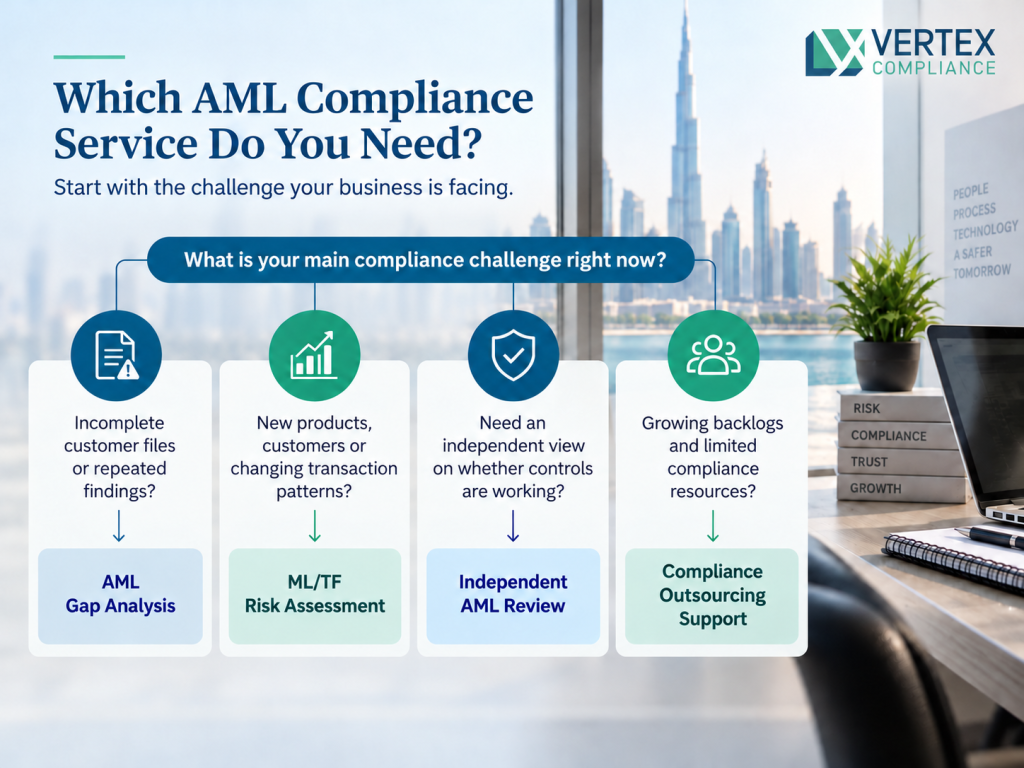
Choose the Service That Fits the Problem

The names of AML services can sound similar. Ask what each engagement will examine and what you will learn from it.

When You Need AML Gap Analysis

An AML gap analysis looks at weaknesses in your existing framework and how it is used.

Consider a file that is missing approval for a high-risk customer. Finding the missing record is useful, but it leaves several questions open. Was approval given by email? Did someone miss the step? Was the customer allowed to transact before approval? Have other files been handled the same way?

Those questions help establish what needs fixing. The answer might be better record keeping, a change to the approval process or a wider review of customer files.

Discuss how much testing is included. Reading a policy will show what staff are expected to do. Examining records helps establish what they actually did.

When Your Risk Assessment Needs Attention

A business can change quite quickly while its risk assessment stays on the shelf.

You may be accepting different customers, handling larger transactions or offering a new payment channel. If the assessment still describes the old business, it may give your team a poor basis for deciding where to focus.

An AML risk assessment in the UAE should take account of your actual operations. Expect to provide information about customers, products, services, transaction activity, countries and the controls already in place.

Ask how the provider will handle missing information. That discussion matters because an assessment is only as useful as the information behind it.

When You Need an Independent Review

Sometimes management needs another view of how the AML programme is working.

An independent assessment may be appropriate when concerns extend across several processes or when earlier findings have not been resolved convincingly.

If the concern is narrow, a more focused engagement may be enough. For example, you may want specific checks on customer risk ratings or screening records.

Agree on what the engagement is intended to establish. Also, clarify the type of report being provided. An agreed-upon procedures engagement reports the factual results of specified checks rather than an overall audit opinion.

When Your Team Needs Help With the Workload

A growing pile of unfinished files may call for operational support.

Compliance outsourcing services can help with defined tasks, but the handover needs planning. Someone must explain the review criteria, answer questions and check completed work.

Suppose the provider finds a customer whose ownership information is unclear. Who requests the missing details? Who decides whether the relationship can continue? Who records the decision?

Settle those responsibilities before the work begins. Check any outsourcing restrictions or approval requirements that apply to your business as well.

Have a Proper Conversation Before Asking for a Price

It is difficult to compare fees when the work has not been defined.

Give each provider the same background information and ask for a written proposal. During the discussion, pay attention to the questions they ask.

Do they want to understand your customer base? Have they asked about previous findings? Do they know which authority supervises your business? Have they explained what information they will need?

A provider that understands the task should be able to describe its approach without hiding behind broad claims about expertise.

Relevant experience is worth checking too. Ask about work involving similar business activities or problems. An anonymised example can be helpful, provided it explains the approach and does not disclose a client’s information.

Read the Scope Carefully

The proposal should tell you what will be examined, how the work will be done and what you will receive.

Look closely at the sample size. A review of a small number of files is different from a review of the whole backlog. Neither is automatically wrong, but they serve different purposes.

Check whether the fee includes meetings to discuss findings, recommendations and a follow-up review. If you expect help making changes, confirm that it is included.

Also, read the exclusions. Work involving an additional system, another business unit or more files may carry an extra charge.

Before signing, you should be able to answer these questions:

  • What work are we paying for?
  • Who will perform and review it?
  • What must our team provide?
  • When will we receive the results?
  • What happens if the scope changes?

If an answer is unclear, resolve it while the proposal is still being discussed.

Be Specific About Access to Customer Information

The provider may need identity documents, ownership records or transaction information. Discuss access before sending anything.

Your team should know where records will be stored, who can view them and whether subcontractors will be involved. Agree on how information will be transferred and what happens to it when the engagement ends.

Include your IT or data protection colleagues where needed. They may identify requirements that the compliance team would not normally deal with.

The same care applies to system access. Work out what access is necessary for the task and who will remove it afterwards.

Think About What Happens After the Report

Receiving a report is one milestone. Addressing the findings is the next job.

Before the review starts, consider who will own the actions. If your team is already stretched, it may struggle to make changes while keeping daily work moving.

Ask whether the provider offers remediation support and what that involves. It could include helping revise a procedure, reviewing corrected records or checking evidence that an action has been completed.

Where that support is outside the scope, plan the work internally. Assign responsibility and make time for it. Otherwise, the same findings may still be waiting when the next review comes around.

Compare Proposals on the Same Basis

Put the scope beside the fee when comparing providers.

A cheaper proposal may include fewer checks. A higher-priced one may include work you do not need. The useful comparison is what each provider will do for the problem you have described.

Look at the extent of testing, the people assigned, the deliverables and the follow-up arrangements. Ask about additional charges before making a decision.

Treat guarantees of compliance or inspection success cautiously. A provider should explain the limits of its work and the results it can reasonably deliver.

Discuss Your Requirements With Vertex Compliance

Vertex Compliance offers AML/CFT compliance services, including gap assessments, independent assessments, ML/TF risk assessments, agreed-upon procedures and sanctions compliance support.

Bring the issues you have already identified to the discussion. If you have previous findings, share them. If your business has changed, explain how. If there is a deadline, mention it at the start.

That gives the team a clearer basis for recommending a scope and explaining what the work will involve.

Explore Vertex Compliance’s AML and CFT services to discuss your requirements.

Frequently Asked Questions

What should I prepare before contacting an AML provider?

Gather your business and licence details, current policies, risk assessments and earlier review findings. Write a short explanation of the problem and the help you need.

What is the difference between AML gap analysis and risk assessment?

Gap analysis examines weaknesses in your existing arrangements. Risk assessment examines the financial crime risks your business faces and the controls used to manage them.

Can a provider help with an existing backlog?

Discuss the records involved, the checks required and the decisions your internal team will retain. Confirm that the proposed arrangement meets any applicable outsourcing requirements.

How much do AML compliance services in the UAE cost?

The cost depends on the work agreed, the complexity of the business and the records being examined. Compare written scopes before comparing prices.

Suspicious Transaction Red Flags UAE Businesses Shouldn’t Ignore

Suspicious transaction red flags

A property buyer signs the agreement, but the payment arrives from an unrelated overseas company. When the broker asks why, the buyer says the sender is “a friend.” No further explanation is offered. A day later, the buyer cancels the deal and asks for the money to be refunded to a different bank account.

Has a crime taken place? There is not enough information to say. Still, several details do not fit together, and ignoring them would be a mistake.

Suspicious transactions are rarely obvious at first. More often, an employee notices a small inconsistency: a payment that does not match the customer’s profile, a third party who appears without explanation or documents that tell different stories.

For businesses covered by the UAE’s anti-money laundering rules, recognising these signs is not optional. Employees must know what deserves a closer look, how to raise an internal concern and when the matter may require reporting to the UAE Financial Intelligence Unit.

What Makes a Transaction Suspicious?

An unusual transaction is not automatically suspicious.

A long-standing customer may receive a much larger payment than usual after selling an asset. A local company may begin making overseas transfers after entering a new market. Both activities are different from the customer’s previous behaviour, but they may have reasonable explanations.

Concern grows when the explanation does not fit the facts.

The customer may claim that the money came from a property sale but fail to provide a sale agreement. An invoice may describe machinery while the customer says the payment was for consulting work. Sometimes the story changes each time someone asks about it.

A business does not need proof of money laundering before escalating a concern. Suspicion may arise when there are reasonable grounds to believe that a transaction, attempted transaction or funds could be linked to criminal activity.

There is no minimum amount. A series of small transfers can matter just as much as one large payment.

Why Suspicious Transaction Red Flags Matter in the UAE

The UAE is a major centre for international finance, trade, property, precious metals and cross-border investment. Most transactions passing through these sectors are legitimate. However, the speed and international reach of the market can also be misused to move or disguise criminal funds.

The volume of reports shows how often businesses encounter activity that requires closer attention. A 2026 report by the Financial Action Task Force states that over GBP 130 million in cash was transported to the UAE within three months and declared as gold-trading funds. The case shows why businesses must question unusual cash movements and trade payments.

An STR does not mean that a person has been found guilty of a crime. It gives the FIU information that can be reviewed alongside reports from other businesses, regulators and government bodies.

Suspicious Transaction Red Flags UAE Businesses Should Watch

One warning sign may have an innocent explanation. Several connected signs, or one serious inconsistency that cannot be resolved, require more attention.

1. The transaction does not fit the customer

A small local consultancy suddenly receives several large international transfers from companies operating in unrelated industries. A customer whose income appears modest purchases a high-value asset without financing. A newly formed business begins moving substantial sums within weeks of opening.

There may be a legitimate reason for any of these situations. The customer could have expanded, received an investment or sold another asset. The explanation should, however, be supported by reliable records.

Suspicious transaction monitoring works only when a company knows what normal activity looks like for each customer. KYC information provides that starting point. For more on establishing this baseline, read our guide to KYC, CDD, and EDD.

2. An unrelated third party sends the money

A customer enters the agreement, but another person pays. A company settles an invoice and later asks for the refund to be sent to a director’s personal account. Funds arrive from an overseas business that has no clear connection to the transaction.

Third-party payments are not prohibited in every case. The business should still understand who sent the money, how that party is connected to the customer and why they are involved.

Vague answers such as “They are helping me” or “We always do it this way” do not resolve the concern. The relationship and reason for payment should make commercial sense and be supported by documents.

3. One payment is divided into smaller amounts

A customer who could pay once chooses to make a series of smaller payments. Different employees, accounts or branches may be used. In some cases, the customer asks how much can be paid without triggering further checks.

There may be practical reasons for separate payments. Concern increases when the transactions happen close together and appear designed to avoid internal controls.

Review the activity as a complete pattern. Looking at each payment on its own can hide what is happening.

4. Funds arrive and leave quickly

Money enters an account and moves elsewhere almost immediately. Little remains, and the customer appears to make no clear profit from the arrangement.

This may suggest that the account or company is being used as a pass-through. Funds might move between several accounts, countries or currencies before reaching their final destination.

Another unusual transaction indicator is a cancellation followed by a refund request to a different account. The change may be valid, but it needs a clear reason.

5. The transaction makes little business sense

A customer agrees to pay far more than an asset appears to be worth. Goods are sent through an unnecessarily complicated route. An invoice uses a vague description such as “general services” and gives no information about what was provided.

Some deals are genuinely complicated. The practical question is: why would a legitimate customer choose to complete this transaction in this way?

If the arrangement creates no obvious commercial benefit but makes the money harder to trace, it should not be dismissed.

6. Ownership is unclear or keeps changing

Complex corporate structures can have valid legal and commercial purposes. The concern begins when nobody can identify the individuals who ultimately own or control the customer.

A company may submit one ownership chart during onboarding and a different version six months later. Shares may move between several entities shortly before a major transaction. Nominee shareholders may appear, but the customer cannot explain whose instructions they follow.

An ownership chart is useful, but it is not proof. The information should be checked against current corporate records. Learn more about how UBO risks affect business risk assessments, including unclear ownership and changes in control.

7. Documents almost look right

False documents are not always poorly made. A bank statement may appear genuine until the account number is compared with another record. An invoice may carry the correct logo but show dates that do not make sense.

Ordinary mistakes happen. People renew passports, move address and spell translated names differently. The issue is whether the difference can be reasonably explained and corrected.

Repeated inconsistencies deserve attention, especially when names, payment amounts, transaction descriptions or company details do not match.

8. The payment follows an unexplained route

A transaction should not be treated as suspicious simply because it involves a particular country. Geography is one part of the assessment, not the entire conclusion.

Questions should be asked when money passes through countries that have no obvious connection to the customer or transaction. The same applies where unknown intermediaries appear or one of the parties may have sanctions exposure.

The payment route, people involved and customer’s explanation must be considered together. A clear sanctions-screening result does not remove every geographic risk.

9. The customer tries to avoid routine checks

Some people become impatient during compliance reviews. Frustration alone does not prove anything.

The behaviour becomes more concerning when a customer offers an incentive to skip a check, asks an employee to leave information out of the records or cancels the transaction as soon as the source of funds is questioned.

Employees should record and escalate the behaviour. They should not accuse the customer or reveal that an STR may be considered.

How Vertex Compliance Can Help

Recognising suspicious activity requires more than a list of warning signs. Businesses need risk-based monitoring rules, clear escalation routes, trained employees and records that show how decisions were made.

Vertex Compliance helps organisations review financial-crime patterns relevant to their customers, products and markets. Our AML/CFT compliance services include typology assessments, AML gap assessments, transaction-monitoring rule optimisation, risk assessments and employee training.

The aim is not to treat every unusual payment as criminal. It is to help the business recognise when something does not fit, investigate it properly and respond before a warning sign becomes a regulatory problem.

Frequently Asked Questions

Does one red flag mean an STR must be filed?

No. A red flag calls for closer review. The reporting decision depends on the facts, the explanation and whether reasonable grounds for suspicion remain.

Is there a minimum amount for an STR?

No fixed monetary threshold determines whether suspicious activity should be reported. Small or attempted transactions can still be relevant.

Who should decide whether to report?

Employees should use the internal escalation process. The compliance officer or MLRO generally reviews the concern and manages any external reporting.

Can the customer be told about the report?

No. The review and filing must remain confidential. Employees should avoid revealing that an STR is being considered or has been submitted.

How often should monitoring rules be reviewed?

Review them when the business changes its products, markets, customers or payment methods. They should also be updated when new risks and financial-crime patterns emerge. Explore our transaction monitoring rule optimisation and threshold tuning services for support with reviewing monitoring rules.

Top 10 Tips for AML Inspection Preparation

AML Inspection Preparation

Anti-Money Laundering (AML) inspections are an important part of the UAE’s efforts to reduce financial crime and ensure businesses follow regulatory requirements, as highlighted in the FATF–MENAFATF Mutual Evaluation Report of the UAE. They help regulators confirm that businesses are not just meeting legal requirements but also applying proper controls in daily operations.

For regulated entities, inspection readiness must not begin only after receiving a notice. Strong AML compliance needs clear policies, trained staff, accurate records and regular risk reviews throughout the year. The guide explains what to review, which documents to organise for AML inspection preparation, and how to help your team respond confidently.

What is an AML Inspection?

An AML inspection is a regulatory review conducted to evaluate whether a business is meeting its Anti-Money Laundering and Counter-Terrorist Financing (AML/CFT) obligations. Inspectors may review whether the company can identify suspicious customers and transactions and report them efficiently. AML supervisors may use on-site visits, transaction sampling, desk-based reviews and interviews with staff.

Why is an AML Inspection Preparation Important?

Preparation is important because regulators assess both your written policies and whether controls work effectively in day-to-day operations. It can help detect if any missing KYC records are there, along with other key details such as owner information and outdated risk assessments. Businesses maintaining strong compliance frameworks are usually better prepared for inspections.

How to Prepare for an AML Inspection?

Regulators want to understand whether your controls work consistently in daily operations. Clear documentation and a clear process for those who understand their responsibilities will make the inspection far more manageable. Here is an AML inspection checklist. 

  1. Review your AML policies and procedures

Verify if your AML policies reflect current regulations, products, business activities, customers and geographical risks. Make sure that the written procedures clearly explain how customer checks, monitoring, reporting and escalation are handled. The process described in the policy must match employees’ responsibilities.

  1. Run a Mock Inspection

Test how your business would respond to a real inspection. Ask your team to find requested documents, explain key processes, and walk through sample customer files and transaction cases. This can reveal delays, missing records, and unclear responsibilities before the regulator does.

  1. Review Customer Files

Audit a sample of customer files to identify missing or outdated information. Names, identity documents, addresses, ownership details, and risk levels should be clearly registered. Proper approval and extra checks should also be in place for higher-risk customers.

  1. Revisit your Risk Assessment

Your risk assessment should identify what are likely to be your most significant money laundering risks. This could be specific customers, countries, services or means of payment. Make it practical, showing how your business deals with each risk you have identified.

  1. Check Transaction Monitoring and Alerts

Make sure unusual transactions are identified and checked on time, whether your process is manual or automated. Each decision should clearly show what was examined and why the activity was closed or reported.

  1. Verify how Suspicious Activity is Reported

Employees should know who to contact when something looks unusual. Your records should show when a concern was raised, how it was reviewed, and what decision was made. Even when no report is submitted, the reason should still be written down.

  1. Check Sanctions and PEP Screening

Make sure customers and relevant connected parties are checked against sanctions and politically exposed person lists. Screening should continue throughout the customer relationship, and possible matches should be investigated and recorded.

  1. Keep AML Training Records Up to Date

Keep a clear record of who completed AML training and when. Training should be easy to understand and relevant to each employee’s role. Staff should know how to recognise warning signs and what to do when they notice something unusual.

  1. Prepare Your Team for Questions

Inspectors may speak directly with employees, so staff should understand their responsibilities. They do not need to memorise formal answers. They should simply be able to explain what they do, what warning signs they look for, and who they contact when they have concerns.

  1. Be Open about Existing Gaps

Don’t hide issues you already know about. What’s the problem? How did it get there? What are you going to do about it? As a rule, pretending that you have no weaknesses is worse than having a clear plan for improvement.

What Happens During an AML Inspection?

During the inspection, the regulator may review your AML policy, records of customers, risk assessments, training documents and reports of unusual activity. They may also ask staff how they handle customer cheques or concerns. The aim is to test your AML process on paper and in practice.

What are the Documents Required for an AML Inspection Preparation?

The documentation you’ll be asked to produce will depend on your business, but inspectors will generally want to see AML policies, customer files, risk assessments, training records and evidence of internal checks. Keep these records in full, current and accessible. Disorganised AML documents can make a functioning AML process look unreliable.

What Are the Common AML Inspection Mistakes?

Common mistakes include missing customer information, outdated policies, unclear risk ratings, weak written explanations, and incomplete training records. Another major issue is when employees follow a different process from the one described in the company’s policy. A practice inspection can help uncover these gaps before the regulator finds them.

Stay Ready with AML Periodic Inspections

Regular AML inspections help you spot weak controls before they become regulatory problems. With Vertex Compliance’s AML Periodic Inspection service, you can review your policies, customer records, risk assessments, and reporting process against current UAE requirements. You also receive practical guidance on what needs attention and how to address it. Do not wait for a regulator to uncover avoidable gaps. Request inspection support and prepare your business with greater clarity, control, and confidence before the next inspection.

Frequently Asked Questions

Will I be notified before an AML inspection?

Some inspections are scheduled; others can be unannounced. This is why it is important to keep your records and processes organised throughout the year. If you wait until you receive the inspection notice to review everything, you’ll end up with rushed fixes and missing information.

What documents should be prepared for an AML audit?

Your AML policies, customer records, risk assessments, training records, internal review reports and reporting documents should be current and easy to find. Inspectors may request records from a variety of dates, so don’t simply prepare the latest files.

Will the inspectors talk directly with the employees?

Yes, employees could be questioned about how they check customers, identify irregular activity and report concerns. Staff don’t need rehearsed answers, but they do need to understand their role and be able to describe the process in their own words.

What happens if an inspector finds gaps?

You may be asked to explain the issue and provide a plan for correcting it. Trying to hide a weakness can create a bigger problem. It is better to show that the gap has been identified, someone is responsible for fixing it, and corrective work has started.

How can Vertex Compliance support inspection readiness?

Vertex Compliance can review your AML controls, identify missing or weak areas, and help organise the records needed during an inspection. The team can also prepare employees for likely questions and provide a practical action plan so your business knows what to fix first.

Common AML Compliance Gaps Found During Reviews

AML Compliance Gaps

An AML programme may look complete on paper and still fail when reviewed in practice. The UK Financial Conduct Authority’s 2025 report found that most reviewed firms had a business-wide risk assessment, but very few had properly adapted it to their actual risks. The review found that some firms were unable to clearly explain how they were managing the risks they had identified. And these results indicate a bigger problem. AML weaknesses are more about poor implementation than lack of policies. Keep reading to explore the common AML compliance gaps. 

Why AML Gaps Appear During Reviews

Many businesses treat AML compliance as a document exercise. They write policies, collect IDs, perform training, but they don’t test those controls to see how they’re working in the real world on a day-to-day basis.

Compliance review includes review of customer files, risk ratings, screening results, alerts, internal reports, training records and management oversight.

A thorough review will show that AML controls are risk-based, applied consistently and supported by evidence. Reviewers must see a clear trail from the identified risk to the action taken, the person responsible and the final decision. Clear the train when there is a change of staff, systems or responsibilities.

What are the Common AML Compliance Gaps Found During Reviews?

1. Generic or Old Risk Assessments

What Reviewers Find

The business risk assessment could be a copy of a template or based on old information. This assessment may not reflect current customers, products, locations, channels or transaction patterns. Some of the assessments list risks but do not explain how the risks were scored or controlled.

How to Repair

Review it from time to time and update the assessment as the business changes. Keep clear records of inherent risk, control effectiveness and residual risk. Each major risk must have a control, owner and review date.

2. Low-risk Customer Ratings

What Reviewers Find

Customers are often labelled low, medium or high risk with no clear rationale. Staff may rely on personal judgment instead of approved risk factors. A change in ownership, activity or transaction behaviour may also leave ratings unchanged.

How to Repair

Use documentable factors such as customer type, geography, ownership, products and expected activity. Determine when a high-risk rating is required. Look for big changes, strange activity or new screener results.

3. Incomplete Customer Due Diligence

What Reviewers Find

Files may have expired IDs, unavailable addresses, or unclear relationship information. Ownership documents or beneficial-owner evidence may not be in company files. Getting papers is not enough. The staff must check that the information is complete, consistent and reliable.

How to Repair

Use a checklist appropriate to the customer’s legal form and level of risk. Verify the information through a reliable person who ultimately owns or controls the entity. Use a chart for complex structures.

4. Poor Beneficial Ownership Checks

What Reviewers Find

Some firms accept the shareholder named on the first company document and do not follow the chain of ownership. The file may not represent the ultimate owner or controller of the customer. Screening checks can also fail to detect beneficial owners.

How to Repair

Trace the chain of ownership to the natural person who ultimately owns or controls the entity. A chart may be useful for complex structures. Verify facts with reliable sources and keep it simple.

5. Inconsistent Enhanced Due Diligence

What Reviewers Find

A high-risk customer may receive the same checks as a low-risk customer. There may be no source of the funds, or senior approval, or more robust monitoring. You can collect more documents without checking the coherence of the information.

How to Repair

Carry out stronger identity checks, verify the source of funds or wealth, obtain senior approval and review the customer more often. Document why the business relationship is acceptable despite the higher risk.

6. Sanction and PEP Screening Gaps

What Reviewers Find

Screening is only available at onboarding. Ownership details or political exposure are subject to change, and customers are not always re-checked. Extra documents may be collected without deciding whether the information makes sense.

How to Repair

Screen customers, beneficial owners and related parties at onboarding and throughout the relationship. Save the date, result, lists checked and decision. Define clear escalation rules and train staff to review aliases, ownership links and possible matches.

7. Ineffective Transaction Monitoring

What Reviewers Find

Rules for monitoring are frequently too broad, too narrow, or irrelevant to the business. This situation leads to many weak alerts and serious activity. Many weak alerts arise from this situation, resulting in the loss of serious activity. It can also make it challenging to spot unusual transactions when there is an absence of expected customer activity.

How to Repair

Monitor real products, customers, channels and risks. Review thresholds as behaviour, services and threats change. Find out why there is each rule and see if it works.

8. Weak Suspicious Activity Escalation

What Reviewers Find

Employees can see suspicious activity but cannot report it. They may assume automated monitoring, or the compliance team will identify the issue. Investigations may remain open without deadlines, evidence or clear decisions.

How to Repair

Establish a transparent internal reporting channel for employees and emphasise role-specific warning signs. Any concerns should be reported promptly to the MLRO or the compliance officer. Use a standard investigation record covering the activity, decision, evidence and reasoning.

9. Policies That Don’t Match Practice

What Reviewers Find

Policies may refer to systems, approval levels, review periods or roles that no longer exist. Employees may do something different than what is written. They do this by comparing policies with files and interviewing staff.

How to Repair

Map every policy requirement to an actual task, owner and record. Update documents when systems, services or responsibilities change. Ask employees to explain the process. There is no room for any gap between policy and practice.

10. Generic Training & Lack of Oversight

What Reviewers Find

Annual training may cover basic AML terminology but may ignore the risks employees face. The staff can get a quiz right and still miss a real red flag. Management reports could omit overdue reviews, high-risk customers, open alerts and unresolved findings.

How to Repair

Provide role-based training with examples from the business. Track attendance, test understanding, and refresh training as risks change. Provide management with clear reports of trends, exceptions and overdue actions. The MLRO should have sufficient authority, information and support.

How to Prepare for an AML Compliance Audit?

Conduct an internal gap assessment using samples of real customer files, alert and transaction samples. Ensure that the written policies align with actual practices.

Interviewing employees reviewing management information and checking that previous findings had been acted upon. Focus on weaknesses that might prevent the business from identifying high-risk customers or suspicious activity.

Close AML Gaps Before They Become Findings

Gaps in AML controls typically occur where risk assessments, customer checks, monitoring, reporting, training and oversight all fail. You can’t fix a bigger control problem by fixing one document.

Vertex Compliance offer services such as finding gaps in AML/CFT, conducting independent evaluations, assessing risks, helping with sanctions compliance, creating policies, performing internal audits, managing KYC services, and providing AML training tailored to specific roles. We can identify weaknesses, develop remedial actions, and prepare your AML programme for independent or regulatory review.

If you need help deciding where to start, our AML/CFT compliance services can help you review your framework and prioritise improvements.

Frequently Asked Questions 

What should we do after AML gaps are found?

Start by creating a clear action plan. Write down what needs to be fixed, who will handle it, and when it should be completed. Keep records of every change so you can show that the business has acted on the review findings. 

Which AML gaps should be fixed first?

Deal with the issues that create the greatest risk first. For example, a serious weakness in customer checks or suspicious activity reporting should not be treated the same as a minor filing error. Prioritising the work helps prevent important problems from being delayed.

Who is responsible for fixing AML compliance gaps?

The compliance officer usually coordinates the work, but fixing the gaps may involve several teams. Senior management should also follow the progress and make sure the right people, time, and resources are available. AML compliance cannot be left to one employee alone. 

How can we prevent the same gaps from appearing again?

Do not treat the review as a one-time exercise. Check that the new process is actually being followed, provide refresher training, and review the corrected areas again. Regular checks help confirm that the problem has been properly fixed rather than temporarily covered up. 

How can Vertex Compliance help close AML gaps?

Vertex Compliance can review your existing AML framework, identify areas that need attention, and provide a practical roadmap for improvement. The support is tailored to your business, helping your team understand what to fix and how to strengthen its compliance process.

What is AML/CFT Compliance in the UAE?

AML/CFT Compliance UAE

The UAE market is fast moving and tightly regulated. Opportunities take time to develop quickly, but so can exposure to financial crime. A customer that looks legitimate, but has a complex ownership structure, can trigger red flags that your business can’t afford to ignore. 

That’s where AML/CFT compliance begins. It is not just a file prepared for an inspection, but how a company understands risk and protects its license, reputation, and commercial relationships. Let us explore what AML/CFT compliance UAE means, why it matters and where the responsibility really begins. 

What is AML?

Money laundering is the process of disguising the proceeds of crime as legitimate funds. In the UAE this might mean moving money through businesses, bank accounts, property deals, trade transactions or high value goods to disguise the source of the money. The activity is frequently staged, and difficult to detect without proper checks. 

Money laundering is a crucial issue for UAE businesses, even an unintentional failure to flag suspicious activity can result in significant regulatory and reputational risk. AML or anti money laundering refers to a global framework that carries out stringent customer due diligence, transaction monitoring and timely reporting to protect businesses against financial crime.

What is CFT?

CFT stands for Countering the Financing of Terrorism. The money is from illegal or legitimate sources (money laundering is always illegal money) so may be harder to spot. 

It involves identifying who their customers and beneficial owners are, where their funds come from, monitoring transactions for suspicious activity and reporting concerns through the appropriate channels. These controls help to protect businesses from legal and reputational harm, as well as supporting the UAE’s efforts to maintain a secure and trusted financial system globally.

Why does AML/CFT Compliance UAE matters for banking organisations?

Here is why compliance matters.

1. Banking professionals are the first line of protection

The Central Bank of the UAE considers banking professionals as the first line of defence. They can spot problems easily and prevent suspicious activity from worsening. 

2. Accurate customer due diligence helps

UAE licensed financial institutions are not permitted to accept anonymous accounts or fictitious identities. Banking professionals must also understand ownership structures, beneficial owners, business activities and the expected source of funds. This allows the bank to make the right decisions based on proper due diligence, not just the documents gathered at onboarding.

3. Spots suspicious activity

Suspicious activity may always not look like a large cash deposit or an illegal transaction. Frequent movement of cash without any clear ground, sudden changes in the behaviour of the account can all be accounted for by suspicious activity. Early identification helps banks to investigate well and escalate concerns faster.  

4. Enables timely and accurate reporting

In case of any suspicious matters, it should be referred to the relevant internal team without delay. The compliance function or MLRO can then decide if a report should be submitted to the UAE Financial Intelligence Unit. Employees must provide clear facts, details of the transaction, customer information and why the activity seemed unusual. 

5. Makes sanctions stronger and blocks terrorist funding

Banks shall ensure that funds and financial services are not made available to sanctioned individuals, organisations or parties linked to terrorist financing. Banking professionals must be alert to transactions that could imitate the real beneficiary.

Who must follow AML/CFT regulations in the UAE?

The following businesses and professionals may be exposed to the risks of money laundering or CFT. 

  • Banking, money changing and financial houses
  • Insurance companies and insurance personnel
  • Payments service providers
  • Hawala providers (licensed)   
  • Real estate agents & brokers
  • Dealers in precious metals and stones 
  • Independent public accountants and auditors
  • Trustees & corporate service lawyers and legal advisers  
  • Providers in connection with certain financial or commercial transactions licensed crypto exchanges, brokers and custodians (virtual asset service providers) 

Compliance requirements are specific to the business activity, the licence and the supervisory authority.

What happens if a business is non-compliant?   

Failure to comply with the AML/CFT requirements may lead to severe consequences, including:

Regulatory action

The supervisory authorities may inspect, take corrective measures, limit operations, suspend operations or act against the company’s licence. 

Financial penalties

Companies could be hit with large administrative fines. According to the Central Bank of UAE report 2024, UAE regulators have imposed multi-million-dirham penalties on businesses who have failed to comply with the AML/CFT systems and controls. 

Reputational damage

Public enforcement actions can reduce confidence among customers, banks, investors and business partners.   

Business disruption

The company may need to review customer files, tighten controls, retrain staff and make significant investment in urgent remediation. This raises the cost and disrupts routine.

In extreme cases the breach may also be subject to criminal penalties depending on the nature of the offence.

Does your AML/CFT framework work in practice?

Understanding AML/CFT requirements is only the first step. It will be the real test for UAE banks and financial institutions as to whether customer due diligence, sanctions screening, transaction monitoring, risk assessments and internal reporting processes work consistently across the organisation.

Teams managing these processes on a day-to-day basis don’t always see the gaps in compliance. An independent review can help find weaknesses before they become regulatory findings, financial losses or reputational damage.

Vertex Compliance provides UAE organisations with AML/CFT gap assessments, independent assessments, ML/TF risk assessments, sanctions compliance, typology assessments and monitoring-rule optimisation. Our approach is customised to the institution’s risk profile, operations and regulatory requirements.

Are you confident in your existing controls to hold up to regulatory scrutiny? Explore our AML/CFT compliance services in the UAE to see the types of reviews and support available for your business.

FAQs

1. What is AML/CFT compliance UAE?

AML/CFT means anti-money laundering and counter terrorist financing systems and controls. In the UAE, financial institutions must understand their exposure to financial crime, verify customers, monitor transactions, screen relevant parties and report suspicious activity. The framework should be commensurate with the size of the institution, the services it offers, the customers it serves, its delivery channels and its geographical risks.

2. Who is regulated by the AML/CFT regulations in the UAE?

Licensed banks and other financial institutions supervised by the CBUAE are subject to the relevant UAE AML/CFT requirements. These include exchange houses, finance companies, payment service providers, registered hawala providers and other regulated financial institutions. This is not just the responsibility of the MLRO or compliance department. Accountability extends to senior management, onboarding teams, relationship managers, operations staff and employees involved in customer transactions.

3. What are the main AML/CFT obligations imposed on banks in the UAE?

UAE banks have to adopt a risk-based approach for customer due diligence, beneficial ownership verification, transaction monitoring, sanctions screening, record-keeping and suspicious activity reporting. More risky relationships might need more due diligence and more frequent ongoing monitoring. Banks should have adequate governance, staff training, internal reporting and independent testing arrangements; The CBUAE AML/CFT Rulebook is the single point of reference for licensed financial institutions.

4. What are the consequences if a financial institution does not comply?

Weak AML/CFT controls can have serious consequences for a UAE financial institution including regulatory findings, remediation requirements, financial penalties, operational restrictions and reputational damage. Monitoring of compliance is done through on-site examinations, off-site supervision, thematic reviews and enforcement actions. Paper policies are not enough anymore. Institutions need to demonstrate that their controls are not only in place but also work in practice.

5. How can Vertex Compliance help you on AML/CFT compliance?

Vertex Compliance gives UAE financial institutions the means to determine whether their AML/CFT controls are aligned with their regulatory requirements and true risk profile. Services include AML/CFT gap assessments, independent assessments, ML/TF risk assessments, sanctions compliance reviews, typology assessments, proliferation financing risk assessments and monitoring rule optimisation. A focused review will uncover vulnerabilities that internal teams miss.