Suppose your business has an AML review coming up. You pull a few customer files to check whether everything is in order. One has an expired document. Another has a risk rating with no explanation. A third is missing an approval.
You now have two jobs: find out how far the problem goes and decide who will fix it.
This is often where the search for AML compliance services in the UAE begins. The business already has policies and people handling compliance. What it needs is help with something specific.
Before comparing providers, spend some time working out what that something is. Otherwise, you could pay for a broad review when you need help clearing a backlog, or pay for file updates without addressing the process that caused the backlog.
What Is Making You Look for Support?
Start with what has happened in your business.
Perhaps an internal review found incomplete customer records. Your compliance officer may be spending too much time chasing documents. You might have introduced a new service and need to revisit the risks involved.
These situations should lead to different conversations with a provider.
For a backlog, explain how many files are waiting and what needs to be checked. For recurring findings, share the earlier reports and the actions taken so far. For a business change, describe the new service, the customers involved and how transactions will work.
You do not need to diagnose everything before asking for help. You do need to give the provider enough information to make a sensible recommendation.
Choose the Service That Fits the Problem
The names of AML services can sound similar. Ask what each engagement will examine and what you will learn from it.
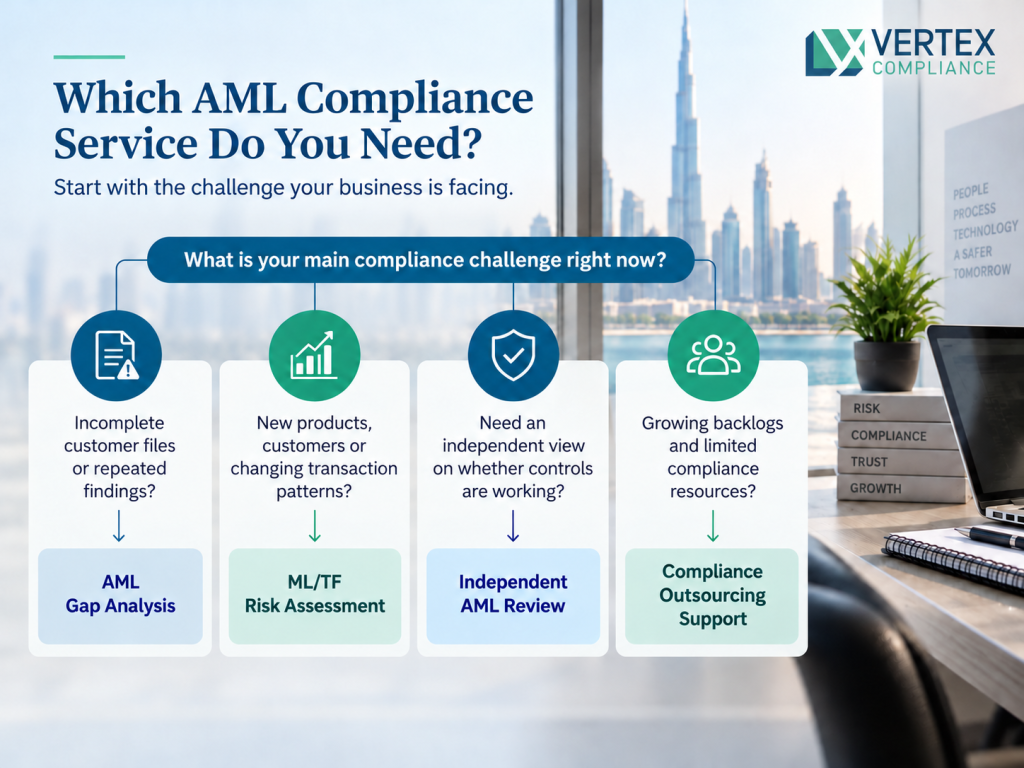
When You Need AML Gap Analysis
An AML gap analysis looks at weaknesses in your existing framework and how it is used.
Consider a file that is missing approval for a high-risk customer. Finding the missing record is useful, but it leaves several questions open. Was approval given by email? Did someone miss the step? Was the customer allowed to transact before approval? Have other files been handled the same way?
Those questions help establish what needs fixing. The answer might be better record keeping, a change to the approval process or a wider review of customer files.
Discuss how much testing is included. Reading a policy will show what staff are expected to do. Examining records helps establish what they actually did.
When Your Risk Assessment Needs Attention
A business can change quite quickly while its risk assessment stays on the shelf.
You may be accepting different customers, handling larger transactions or offering a new payment channel. If the assessment still describes the old business, it may give your team a poor basis for deciding where to focus.
An AML risk assessment in the UAE should take account of your actual operations. Expect to provide information about customers, products, services, transaction activity, countries and the controls already in place.
Ask how the provider will handle missing information. That discussion matters because an assessment is only as useful as the information behind it.
When You Need an Independent Review
Sometimes management needs another view of how the AML programme is working.
An independent assessment may be appropriate when concerns extend across several processes or when earlier findings have not been resolved convincingly.
If the concern is narrow, a more focused engagement may be enough. For example, you may want specific checks on customer risk ratings or screening records.
Agree on what the engagement is intended to establish. Also, clarify the type of report being provided. An agreed-upon procedures engagement reports the factual results of specified checks rather than an overall audit opinion.
When Your Team Needs Help With the Workload
A growing pile of unfinished files may call for operational support.
Compliance outsourcing services can help with defined tasks, but the handover needs planning. Someone must explain the review criteria, answer questions and check completed work.
Suppose the provider finds a customer whose ownership information is unclear. Who requests the missing details? Who decides whether the relationship can continue? Who records the decision?
Settle those responsibilities before the work begins. Check any outsourcing restrictions or approval requirements that apply to your business as well.
Have a Proper Conversation Before Asking for a Price
It is difficult to compare fees when the work has not been defined.
Give each provider the same background information and ask for a written proposal. During the discussion, pay attention to the questions they ask.
Do they want to understand your customer base? Have they asked about previous findings? Do they know which authority supervises your business? Have they explained what information they will need?
A provider that understands the task should be able to describe its approach without hiding behind broad claims about expertise.
Relevant experience is worth checking too. Ask about work involving similar business activities or problems. An anonymised example can be helpful, provided it explains the approach and does not disclose a client’s information.
Read the Scope Carefully
The proposal should tell you what will be examined, how the work will be done and what you will receive.
Look closely at the sample size. A review of a small number of files is different from a review of the whole backlog. Neither is automatically wrong, but they serve different purposes.
Check whether the fee includes meetings to discuss findings, recommendations and a follow-up review. If you expect help making changes, confirm that it is included.
Also, read the exclusions. Work involving an additional system, another business unit or more files may carry an extra charge.
Before signing, you should be able to answer these questions:
- What work are we paying for?
- Who will perform and review it?
- What must our team provide?
- When will we receive the results?
- What happens if the scope changes?
If an answer is unclear, resolve it while the proposal is still being discussed.
Be Specific About Access to Customer Information
The provider may need identity documents, ownership records or transaction information. Discuss access before sending anything.
Your team should know where records will be stored, who can view them and whether subcontractors will be involved. Agree on how information will be transferred and what happens to it when the engagement ends.
Include your IT or data protection colleagues where needed. They may identify requirements that the compliance team would not normally deal with.
The same care applies to system access. Work out what access is necessary for the task and who will remove it afterwards.
Think About What Happens After the Report
Receiving a report is one milestone. Addressing the findings is the next job.
Before the review starts, consider who will own the actions. If your team is already stretched, it may struggle to make changes while keeping daily work moving.
Ask whether the provider offers remediation support and what that involves. It could include helping revise a procedure, reviewing corrected records or checking evidence that an action has been completed.
Where that support is outside the scope, plan the work internally. Assign responsibility and make time for it. Otherwise, the same findings may still be waiting when the next review comes around.
Compare Proposals on the Same Basis
Put the scope beside the fee when comparing providers.
A cheaper proposal may include fewer checks. A higher-priced one may include work you do not need. The useful comparison is what each provider will do for the problem you have described.
Look at the extent of testing, the people assigned, the deliverables and the follow-up arrangements. Ask about additional charges before making a decision.
Treat guarantees of compliance or inspection success cautiously. A provider should explain the limits of its work and the results it can reasonably deliver.
Discuss Your Requirements With Vertex Compliance
Vertex Compliance offers AML/CFT compliance services, including gap assessments, independent assessments, ML/TF risk assessments, agreed-upon procedures and sanctions compliance support.
Bring the issues you have already identified to the discussion. If you have previous findings, share them. If your business has changed, explain how. If there is a deadline, mention it at the start.
That gives the team a clearer basis for recommending a scope and explaining what the work will involve.
Explore Vertex Compliance’s AML and CFT services to discuss your requirements.
Frequently Asked Questions
What should I prepare before contacting an AML provider?
Gather your business and licence details, current policies, risk assessments and earlier review findings. Write a short explanation of the problem and the help you need.
What is the difference between AML gap analysis and risk assessment?
Gap analysis examines weaknesses in your existing arrangements. Risk assessment examines the financial crime risks your business faces and the controls used to manage them.
Can a provider help with an existing backlog?
Discuss the records involved, the checks required and the decisions your internal team will retain. Confirm that the proposed arrangement meets any applicable outsourcing requirements.
How much do AML compliance services in the UAE cost?
The cost depends on the work agreed, the complexity of the business and the records being examined. Compare written scopes before comparing prices.