Call us today +971 - 56411 3575 or +971 - 58914 9282 | Email: info@vertexcompliance.com

KYC, CDD & EDD: What’s the Difference?

KYC VS CDD VS EDD

Compliance practitioners know KYC (Know Your Customer), CDD (Customer Due Diligence) and EDD (Enhanced Due Diligence), but sometimes these terms are used interchangeably. Each plays a different role in helping businesses understand customers and manage financial crime risk.

KYC is all about who the customer is. CDD is a look at the overall risk of the customer and EDD is used when the risk is higher and needs to be looked at more closely.

Compliance teams can apply the right checks at the right time by understanding the difference between KYC, CDD and EDD. This also helps standardise onboarding and ongoing monitoring. Keep reading to explore more about KYC vs CDD vs EDD. 

What is Know Your Customer (KYC)?

Know Your Customer, often shortened to KYC, is the process of verifying a customer’s identity. It helps businesses ensure that the person or the company is legit.

For individuals, it needs verification of his / her name, date of birth, address and identity documents. For a business, it can include company registration details, directors, shareholders and beneficial owners.

KYC answers who is the customer, and is generally done at the time of onboarding. But customer information may also need to be refreshed later when important details change.

Business KYC often requires more than just verifying a company name. Compliance teams may need to know who owns, controls or benefits from the company.

This is particularly so where ownership is split between a number of companies or jurisdictions. It is easier to correctly assess the customer when the ownership information is clear.

What is Customer Due Diligence (CDD)?

Customer Due Diligence (CDD) is more than checking a customer’s identity. It helps a business to understand the customer, their relationship and what risk is involved.

It reviews the customer’s business activity, occupation, ownership structure, expected transactions, and geographic exposure. The idea is to know what normal activity should look like.

The underlying question CDD answers is: How risky is this customer?

This is where KYC and CDD are different. KYC verifies the identity and CDD uses more data to build a customer risk profile.

CDD also helps a company to understand how the customer is likely to use its products or services. This provides a useful baseline for future monitoring.

For example, a small local business would be expected to have very different transaction patterns than an international trading company. Major deviations from expected activity may require further review.

What Is Enhanced Due Diligence (EDD)?

Enhanced Due Diligence or EDD is a more detailed review for higher risk customers when standard CDD doesn’t give enough information to understand or manage the risk. EDD might require additional documents, more independent checks, or a closer look at ownership and financial activity. The review should focus on the specific risks that led to the customer being treated as higher risk.

The main question EDD asks is: Is this increased risk understood and reduced?

EDD does not necessarily mean rejection of the customer. This gives the business more information before they make that decision.

It may also involve additional due diligence on the customer’s background, business activities, ownership, source of funds or source of wealth. Independent information may also be used to verify the information provided by the customer. Customers with a higher risk may need to be monitored more frequently. It helps businesses to detect changes or anomalies earlier. Monitoring should be related to the already identified risks. It is not a review of every minor activity which is not a need.

When is EDD Needed?

EDD may be necessary where the customer presents factors that are a higher level of financial crime risk. These factors should be defined in the risk framework and the internal procedures of the organisation.

Examples include complex ownership, unusual transaction activity, links to higher risk jurisdictions, politically exposed persons or information that is difficult to verify.

EDD may be required in cases where regular CDD has been a cause for concern. If the customer information doesn’t make sense or you can’t confirm important details, it may be appropriate to do a deeper review.

Just because there’s a higher risk factor doesn’t mean suspicious activity is happening. It simply means that the business needs more information to make a good decision.

KYC, CDD and EDD: What’s the difference?

AspectKYCCDDEDD
Full FormKnow Your CustomerCustomer Due DiligenceEnhanced Due Diligence
Main PurposeConfirm who the customer isUnderstand the customer and their riskLook more closely at higher-risk customers
Level of ReviewBasic checksStandard checksMore detailed checks
When It Is UsedMainly during onboardingDuring onboarding and ongoing reviewsWhen higher-risk factors are found
Typical ChecksName, address, date of birth, ID documentsIdentity, ownership, business activity, expected transactionsSource of funds, source of wealth, ownership details, extra verification
Risk FocusConfirms identityHelps decide the customer’s risk levelLooks more closely at higher-risk areas
Information NeededBasic identity detailsMore information about the customerAdditional details and proof
MonitoringMainly initial checksOngoing customer reviewsCloser or more frequent reviews
Key QuestionWho is the customer?What risk does this customer present?Do we understand this higher risk well enough?
Role in ComplianceConfirms customer identityBuilds an understanding of customer riskHelps investigate higher-risk customers

The best way to understand KYC, CDD and EDD is to look at the purpose of each process. They are closely interconnected, but each performs a different degree of review.

The three processes should not be viewed as separate exercises. All of these are part of one customer risk management process.

How Does It Work?

The process starts with KYC. The business collects and verifies enough information to establish that the customer is who he says he is.

Then CDD helps the business understand why the customer needs the service, what activity is expected, and what risks might be present.

The information obtained can then be used to assign a risk rating to the customer. Lower risk customers can stay with standard controls and higher risk customers can move to EDD.

Onboarding is not the end of the process. Customer risk can be affected by changes such as to ownership, transaction behavior, business activity or location.

Common Mistakes of KYC, CDD and EDD

Avoid these mistakes to prevent bigger compliance gaps down the line:

Document-Only Checks

Some teams are of the perception that KYC is just collecting identity documents. That misses the bigger picture of knowing who the customer is and does this information make sense.

Uniform Checks

The same checks applied to every customer can be inefficient. Customers with lower risks may suffer unwarranted delays, and those with a real higher risk may not receive enough attention.

Weak Justification

You should not use EDD simply because a customer looks unusual. Any request for further information should be clearly justified on a risk basis.

Poor Documentation

Compliance teams should note why a customer received a particular risk rating. They should also record what checks were carried out and the reasons for the decision.

Outdated Information

Customer risk is time-dependent. If the ownership, business or transaction information becomes outdated, the original risk assessment may no longer be valid.

Missed Changes

A customer could appear to be low risk at onboarding but turn out to be higher risk later. Major changes in behavior or ownership should be reviewed.

Get KYC, CDD, and EDD Right

KYC, CDD and EDD are related but they are for different purposes. KYC is verifying the customer identity, CDD is knowing the customer and risk profiling and EDD is extra checks when there are high risk factors.

The best way is to not put the most checks on each customer. This means applying the right level of review based on the level of actual risk, keeping clear records and revising the assessment if customer circumstances change.

Frequently Asked Questions 

1. When should a customer’s risk profile be reviewed?

Customer risk should be reviewed periodically and whenever there is a significant change in activity, ownership, location, transaction behaviour, or other relevant risk factors.

2. What can trigger additional customer verification?

Triggers may include unusual transactions, changes in beneficial ownership, links to high-risk jurisdictions, sanctions exposure, inconsistent information, or unexpected changes in customer behaviour.

3. What records should businesses keep during customer checks?

Businesses should maintain identification records, verification evidence, risk assessments, screening results, supporting documents, review notes, and records explaining important compliance decisions.

4. Can customer due diligence processes be automated?

Parts of the process can be automated using identity verification, screening, risk scoring, and monitoring tools. However, higher-risk cases may still require manual assessment and compliance judgement.

5. What happens if customer information becomes outdated?

Outdated information can affect the accuracy of a customer’s risk assessment. Businesses may need to obtain updated documents, repeat relevant checks, and reassess the relationship.

6. How often should businesses update customer information?

There is no single review frequency suitable for every customer. Review schedules are generally determined by the customer’s risk level, regulatory requirements, and changes identified during ongoing monitoring.

Top 10 Tips for AML Inspection Preparation

AML Inspection Preparation

Anti-Money Laundering (AML) inspections are an important part of the UAE’s efforts to reduce financial crime and ensure businesses follow regulatory requirements, as highlighted in the FATF–MENAFATF Mutual Evaluation Report of the UAE. They help regulators confirm that businesses are not just meeting legal requirements but also applying proper controls in daily operations.

For regulated entities, inspection readiness must not begin only after receiving a notice. Strong AML compliance needs clear policies, trained staff, accurate records and regular risk reviews throughout the year. The guide explains what to review, which documents to organise for AML inspection preparation, and how to help your team respond confidently.

What is an AML Inspection?

An AML inspection is a regulatory review conducted to evaluate whether a business is meeting its Anti-Money Laundering and Counter-Terrorist Financing (AML/CFT) obligations. Inspectors may review whether the company can identify suspicious customers and transactions and report them efficiently. AML supervisors may use on-site visits, transaction sampling, desk-based reviews and interviews with staff.

Why is an AML Inspection Preparation Important?

Preparation is important because regulators assess both your written policies and whether controls work effectively in day-to-day operations. It can help detect if any missing KYC records are there, along with other key details such as owner information and outdated risk assessments. Businesses maintaining strong compliance frameworks are usually better prepared for inspections.

How to Prepare for an AML Inspection?

Regulators want to understand whether your controls work consistently in daily operations. Clear documentation and a clear process for those who understand their responsibilities will make the inspection far more manageable. Here is an AML inspection checklist. 

  1. Review your AML policies and procedures

Verify if your AML policies reflect current regulations, products, business activities, customers and geographical risks. Make sure that the written procedures clearly explain how customer checks, monitoring, reporting and escalation are handled. The process described in the policy must match employees’ responsibilities.

  1. Run a Mock Inspection

Test how your business would respond to a real inspection. Ask your team to find requested documents, explain key processes, and walk through sample customer files and transaction cases. This can reveal delays, missing records, and unclear responsibilities before the regulator does.

  1. Review Customer Files

Audit a sample of customer files to identify missing or outdated information. Names, identity documents, addresses, ownership details, and risk levels should be clearly registered. Proper approval and extra checks should also be in place for higher-risk customers.

  1. Revisit your Risk Assessment

Your risk assessment should identify what are likely to be your most significant money laundering risks. This could be specific customers, countries, services or means of payment. Make it practical, showing how your business deals with each risk you have identified.

  1. Check Transaction Monitoring and Alerts

Make sure unusual transactions are identified and checked on time, whether your process is manual or automated. Each decision should clearly show what was examined and why the activity was closed or reported.

  1. Verify how Suspicious Activity is Reported

Employees should know who to contact when something looks unusual. Your records should show when a concern was raised, how it was reviewed, and what decision was made. Even when no report is submitted, the reason should still be written down.

  1. Check Sanctions and PEP Screening

Make sure customers and relevant connected parties are checked against sanctions and politically exposed person lists. Screening should continue throughout the customer relationship, and possible matches should be investigated and recorded.

  1. Keep AML Training Records Up to Date

Keep a clear record of who completed AML training and when. Training should be easy to understand and relevant to each employee’s role. Staff should know how to recognise warning signs and what to do when they notice something unusual.

  1. Prepare Your Team for Questions

Inspectors may speak directly with employees, so staff should understand their responsibilities. They do not need to memorise formal answers. They should simply be able to explain what they do, what warning signs they look for, and who they contact when they have concerns.

  1. Be Open about Existing Gaps

Don’t hide issues you already know about. What’s the problem? How did it get there? What are you going to do about it? As a rule, pretending that you have no weaknesses is worse than having a clear plan for improvement.

What Happens During an AML Inspection?

During the inspection, the regulator may review your AML policy, records of customers, risk assessments, training documents and reports of unusual activity. They may also ask staff how they handle customer cheques or concerns. The aim is to test your AML process on paper and in practice.

What are the Documents Required for an AML Inspection Preparation?

The documentation you’ll be asked to produce will depend on your business, but inspectors will generally want to see AML policies, customer files, risk assessments, training records and evidence of internal checks. Keep these records in full, current and accessible. Disorganised AML documents can make a functioning AML process look unreliable.

What Are the Common AML Inspection Mistakes?

Common mistakes include missing customer information, outdated policies, unclear risk ratings, weak written explanations, and incomplete training records. Another major issue is when employees follow a different process from the one described in the company’s policy. A practice inspection can help uncover these gaps before the regulator finds them.

Stay Ready with AML Periodic Inspections

Regular AML inspections help you spot weak controls before they become regulatory problems. With Vertex Compliance’s AML Periodic Inspection service, you can review your policies, customer records, risk assessments, and reporting process against current UAE requirements. You also receive practical guidance on what needs attention and how to address it. Do not wait for a regulator to uncover avoidable gaps. Request inspection support and prepare your business with greater clarity, control, and confidence before the next inspection.

Frequently Asked Questions

Will I be notified before an AML inspection?

Some inspections are scheduled; others can be unannounced. This is why it is important to keep your records and processes organised throughout the year. If you wait until you receive the inspection notice to review everything, you’ll end up with rushed fixes and missing information.

What documents should be prepared for an AML audit?

Your AML policies, customer records, risk assessments, training records, internal review reports and reporting documents should be current and easy to find. Inspectors may request records from a variety of dates, so don’t simply prepare the latest files.

Will the inspectors talk directly with the employees?

Yes, employees could be questioned about how they check customers, identify irregular activity and report concerns. Staff don’t need rehearsed answers, but they do need to understand their role and be able to describe the process in their own words.

What happens if an inspector finds gaps?

You may be asked to explain the issue and provide a plan for correcting it. Trying to hide a weakness can create a bigger problem. It is better to show that the gap has been identified, someone is responsible for fixing it, and corrective work has started.

How can Vertex Compliance support inspection readiness?

Vertex Compliance can review your AML controls, identify missing or weak areas, and help organise the records needed during an inspection. The team can also prepare employees for likely questions and provide a practical action plan so your business knows what to fix first.

Common AML Compliance Gaps Found During Reviews

AML Compliance Gaps

An AML programme may look complete on paper and still fail when reviewed in practice. The UK Financial Conduct Authority’s 2025 report found that most reviewed firms had a business-wide risk assessment, but very few had properly adapted it to their actual risks. The review found that some firms were unable to clearly explain how they were managing the risks they had identified. And these results indicate a bigger problem. AML weaknesses are more about poor implementation than lack of policies. Keep reading to explore the common AML compliance gaps. 

Why AML Gaps Appear During Reviews

Many businesses treat AML compliance as a document exercise. They write policies, collect IDs, perform training, but they don’t test those controls to see how they’re working in the real world on a day-to-day basis.

Compliance review includes review of customer files, risk ratings, screening results, alerts, internal reports, training records and management oversight.

A thorough review will show that AML controls are risk-based, applied consistently and supported by evidence. Reviewers must see a clear trail from the identified risk to the action taken, the person responsible and the final decision. Clear the train when there is a change of staff, systems or responsibilities.

What are the Common AML Compliance Gaps Found During Reviews?

1. Generic or Old Risk Assessments

What Reviewers Find

The business risk assessment could be a copy of a template or based on old information. This assessment may not reflect current customers, products, locations, channels or transaction patterns. Some of the assessments list risks but do not explain how the risks were scored or controlled.

How to Repair

Review it from time to time and update the assessment as the business changes. Keep clear records of inherent risk, control effectiveness and residual risk. Each major risk must have a control, owner and review date.

2. Low-risk Customer Ratings

What Reviewers Find

Customers are often labelled low, medium or high risk with no clear rationale. Staff may rely on personal judgment instead of approved risk factors. A change in ownership, activity or transaction behaviour may also leave ratings unchanged.

How to Repair

Use documentable factors such as customer type, geography, ownership, products and expected activity. Determine when a high-risk rating is required. Look for big changes, strange activity or new screener results.

3. Incomplete Customer Due Diligence

What Reviewers Find

Files may have expired IDs, unavailable addresses, or unclear relationship information. Ownership documents or beneficial-owner evidence may not be in company files. Getting papers is not enough. The staff must check that the information is complete, consistent and reliable.

How to Repair

Use a checklist appropriate to the customer’s legal form and level of risk. Verify the information through a reliable person who ultimately owns or controls the entity. Use a chart for complex structures.

4. Poor Beneficial Ownership Checks

What Reviewers Find

Some firms accept the shareholder named on the first company document and do not follow the chain of ownership. The file may not represent the ultimate owner or controller of the customer. Screening checks can also fail to detect beneficial owners.

How to Repair

Trace the chain of ownership to the natural person who ultimately owns or controls the entity. A chart may be useful for complex structures. Verify facts with reliable sources and keep it simple.

5. Inconsistent Enhanced Due Diligence

What Reviewers Find

A high-risk customer may receive the same checks as a low-risk customer. There may be no source of the funds, or senior approval, or more robust monitoring. You can collect more documents without checking the coherence of the information.

How to Repair

Carry out stronger identity checks, verify the source of funds or wealth, obtain senior approval and review the customer more often. Document why the business relationship is acceptable despite the higher risk.

6. Sanction and PEP Screening Gaps

What Reviewers Find

Screening is only available at onboarding. Ownership details or political exposure are subject to change, and customers are not always re-checked. Extra documents may be collected without deciding whether the information makes sense.

How to Repair

Screen customers, beneficial owners and related parties at onboarding and throughout the relationship. Save the date, result, lists checked and decision. Define clear escalation rules and train staff to review aliases, ownership links and possible matches.

7. Ineffective Transaction Monitoring

What Reviewers Find

Rules for monitoring are frequently too broad, too narrow, or irrelevant to the business. This situation leads to many weak alerts and serious activity. Many weak alerts arise from this situation, resulting in the loss of serious activity. It can also make it challenging to spot unusual transactions when there is an absence of expected customer activity.

How to Repair

Monitor real products, customers, channels and risks. Review thresholds as behaviour, services and threats change. Find out why there is each rule and see if it works.

8. Weak Suspicious Activity Escalation

What Reviewers Find

Employees can see suspicious activity but cannot report it. They may assume automated monitoring, or the compliance team will identify the issue. Investigations may remain open without deadlines, evidence or clear decisions.

How to Repair

Establish a transparent internal reporting channel for employees and emphasise role-specific warning signs. Any concerns should be reported promptly to the MLRO or the compliance officer. Use a standard investigation record covering the activity, decision, evidence and reasoning.

9. Policies That Don’t Match Practice

What Reviewers Find

Policies may refer to systems, approval levels, review periods or roles that no longer exist. Employees may do something different than what is written. They do this by comparing policies with files and interviewing staff.

How to Repair

Map every policy requirement to an actual task, owner and record. Update documents when systems, services or responsibilities change. Ask employees to explain the process. There is no room for any gap between policy and practice.

10. Generic Training & Lack of Oversight

What Reviewers Find

Annual training may cover basic AML terminology but may ignore the risks employees face. The staff can get a quiz right and still miss a real red flag. Management reports could omit overdue reviews, high-risk customers, open alerts and unresolved findings.

How to Repair

Provide role-based training with examples from the business. Track attendance, test understanding, and refresh training as risks change. Provide management with clear reports of trends, exceptions and overdue actions. The MLRO should have sufficient authority, information and support.

How to Prepare for an AML Compliance Audit?

Conduct an internal gap assessment using samples of real customer files, alert and transaction samples. Ensure that the written policies align with actual practices.

Interviewing employees reviewing management information and checking that previous findings had been acted upon. Focus on weaknesses that might prevent the business from identifying high-risk customers or suspicious activity.

Close AML Gaps Before They Become Findings

Gaps in AML controls typically occur where risk assessments, customer checks, monitoring, reporting, training and oversight all fail. You can’t fix a bigger control problem by fixing one document.

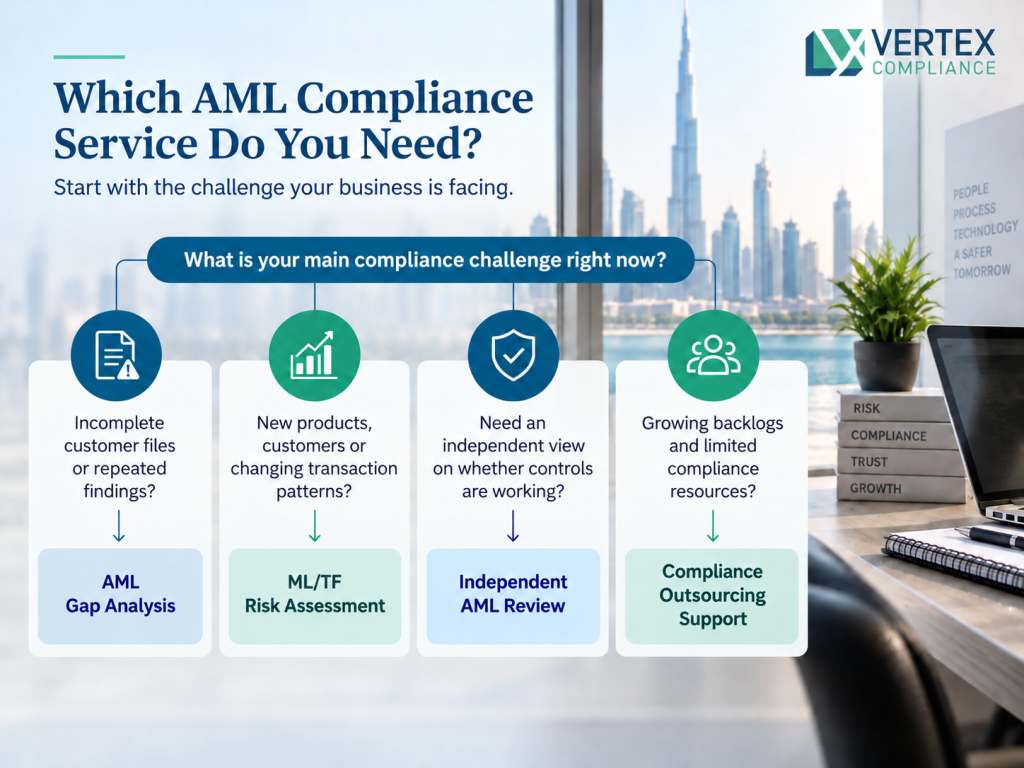
Vertex Compliance offer services such as finding gaps in AML/CFT, conducting independent evaluations, assessing risks, helping with sanctions compliance, creating policies, performing internal audits, managing KYC services, and providing AML training tailored to specific roles. We can identify weaknesses, develop remedial actions, and prepare your AML programme for independent or regulatory review.

Contact us today to discuss your AML requirements and improve your controls before your next compliance review.

Frequently Asked Questions 

What should we do after AML gaps are found?

Start by creating a clear action plan. Write down what needs to be fixed, who will handle it, and when it should be completed. Keep records of every change so you can show that the business has acted on the review findings. 

Which AML gaps should be fixed first?

Deal with the issues that create the greatest risk first. For example, a serious weakness in customer checks or suspicious activity reporting should not be treated the same as a minor filing error. Prioritising the work helps prevent important problems from being delayed.

Who is responsible for fixing AML compliance gaps?

The compliance officer usually coordinates the work, but fixing the gaps may involve several teams. Senior management should also follow the progress and make sure the right people, time, and resources are available. AML compliance cannot be left to one employee alone. 

How can we prevent the same gaps from appearing again?

Do not treat the review as a one-time exercise. Check that the new process is actually being followed, provide refresher training, and review the corrected areas again. Regular checks help confirm that the problem has been properly fixed rather than temporarily covered up. 

How can Vertex Compliance help close AML gaps?

Vertex Compliance can review your existing AML framework, identify areas that need attention, and provide a practical roadmap for improvement. The support is tailored to your business, helping your team understand what to fix and how to strengthen its compliance process.

What is AML/CFT Compliance in the UAE?

AML/CFT Compliance UAE

The UAE market is fast moving and tightly regulated. Opportunities take time to develop quickly, but so can exposure to financial crime. A customer that looks legitimate, but has a complex ownership structure, can trigger red flags that your business can’t afford to ignore. 

That’s where AML/CFT compliance begins. It is not just a file prepared for an inspection, but how a company understands risk and protects its license, reputation, and commercial relationships. Let us explore what AML/CFT compliance UAE means, why it matters and where the responsibility really begins. 

What is AML?

Money laundering is the process of disguising the proceeds of crime as legitimate funds. In the UAE this might mean moving money through businesses, bank accounts, property deals, trade transactions or high value goods to disguise the source of the money. The activity is frequently staged, and difficult to detect without proper checks. 

Money laundering is a crucial issue for UAE businesses, even an unintentional failure to flag suspicious activity can result in significant regulatory and reputational risk. AML or anti money laundering refers to a global framework that carries out stringent customer due diligence, transaction monitoring and timely reporting to protect businesses against financial crime.

What is CFT?

CFT stands for Countering the Financing of Terrorism. The money is from illegal or legitimate sources (money laundering is always illegal money) so may be harder to spot. 

It involves identifying who their customers and beneficial owners are, where their funds come from, monitoring transactions for suspicious activity and reporting concerns through the appropriate channels. These controls help to protect businesses from legal and reputational harm, as well as supporting the UAE’s efforts to maintain a secure and trusted financial system globally.

Why does AML/CFT Compliance UAE matters for banking organisations?

Here is why compliance matters.

1. Banking professionals are the first line of protection

The Central Bank of the UAE considers banking professionals as the first line of defence. They can spot problems easily and prevent suspicious activity from worsening. 

2. Accurate customer due diligence helps

UAE licensed financial institutions are not permitted to accept anonymous accounts or fictitious identities. Banking professionals must also understand ownership structures, beneficial owners, business activities and the expected source of funds. This allows the bank to make the right decisions based on proper due diligence, not just the documents gathered at onboarding.

3. Spots suspicious activity

Suspicious activity may always not look like a large cash deposit or an illegal transaction. Frequent movement of cash without any clear ground, sudden changes in the behaviour of the account can all be accounted for by suspicious activity. Early identification helps banks to investigate well and escalate concerns faster.  

4. Enables timely and accurate reporting

In case of any suspicious matters, it should be referred to the relevant internal team without delay. The compliance function or MLRO can then decide if a report should be submitted to the UAE Financial Intelligence Unit. Employees must provide clear facts, details of the transaction, customer information and why the activity seemed unusual. 

5. Makes sanctions stronger and blocks terrorist funding

Banks shall ensure that funds and financial services are not made available to sanctioned individuals, organisations or parties linked to terrorist financing. Banking professionals must be alert to transactions that could imitate the real beneficiary.

Who must follow AML/CFT regulations in the UAE?

The following businesses and professionals may be exposed to the risks of money laundering or CFT. 

  • Banking, money changing and financial houses
  • Insurance companies and insurance personnel
  • Payments service providers
  • Hawala providers (licensed)   
  • Real estate agents & brokers
  • Dealers in precious metals and stones 
  • Independent public accountants and auditors
  • Trustees & corporate service lawyers and legal advisers  
  • Providers in connection with certain financial or commercial transactions licensed crypto exchanges, brokers and custodians (virtual asset service providers) 

Compliance requirements are specific to the business activity, the licence and the supervisory authority.

What happens if a business is non-compliant?   

Failure to comply with the AML/CFT requirements may lead to severe consequences, including:

Regulatory action

The supervisory authorities may inspect, take corrective measures, limit operations, suspend operations or act against the company’s licence. 

Financial penalties

Companies could be hit with large administrative fines. According to the Central Bank of UAE report 2024, UAE regulators have imposed multi-million-dirham penalties on businesses who have failed to comply with the AML/CFT systems and controls. 

Reputational damage

Public enforcement actions can reduce confidence among customers, banks, investors and business partners.   

Business disruption

The company may need to review customer files, tighten controls, retrain staff and make significant investment in urgent remediation. This raises the cost and disrupts routine.

In extreme cases the breach may also be subject to criminal penalties depending on the nature of the offence.

Does your AML/CFT framework work in practice?

Understanding AML/CFT requirements is only the first step. It will be the real test for UAE banks and financial institutions as to whether customer due diligence, sanctions screening, transaction monitoring, risk assessments and internal reporting processes work consistently across the organisation.

Teams managing these processes on a day-to-day basis don’t always see the gaps in compliance. An independent review can help find weaknesses before they become regulatory findings, financial losses or reputational damage.

Vertex Compliance provides UAE organisations with AML/CFT gap assessments, independent assessments, ML/TF risk assessments, sanctions compliance, typology assessments and monitoring-rule optimisation. Our approach is customised to the institution’s risk profile, operations and regulatory requirements.

Are you confident in your existing controls to hold up to regulatory scrutiny? Book a compliance consultation to review your AML/CFT framework and identify areas for improvement. 

FAQs

1. What is AML/CFT compliance UAE?

AML/CFT means anti-money laundering and counter terrorist financing systems and controls. In the UAE, financial institutions must understand their exposure to financial crime, verify customers, monitor transactions, screen relevant parties and report suspicious activity. The framework should be commensurate with the size of the institution, the services it offers, the customers it serves, its delivery channels and its geographical risks.

2. Who is regulated by the AML/CFT regulations in the UAE?

Licensed banks and other financial institutions supervised by the CBUAE are subject to the relevant UAE AML/CFT requirements. These include exchange houses, finance companies, payment service providers, registered hawala providers and other regulated financial institutions. This is not just the responsibility of the MLRO or compliance department. Accountability extends to senior management, onboarding teams, relationship managers, operations staff and employees involved in customer transactions.

3. What are the main AML/CFT obligations imposed on banks in the UAE?

UAE banks have to adopt a risk-based approach for customer due diligence, beneficial ownership verification, transaction monitoring, sanctions screening, record-keeping and suspicious activity reporting. More risky relationships might need more due diligence and more frequent ongoing monitoring. Banks should have adequate governance, staff training, internal reporting and independent testing arrangements; The CBUAE AML/CFT Rulebook is the single point of reference for licensed financial institutions.

4. What are the consequences if a financial institution does not comply?

Weak AML/CFT controls can have serious consequences for a UAE financial institution including regulatory findings, remediation requirements, financial penalties, operational restrictions and reputational damage. Monitoring of compliance is done through on-site examinations, off-site supervision, thematic reviews and enforcement actions. Paper policies are not enough anymore. Institutions need to demonstrate that their controls are not only in place but also work in practice.

5. How can Vertex Compliance help you on AML/CFT compliance?

Vertex Compliance gives UAE financial institutions the means to determine whether their AML/CFT controls are aligned with their regulatory requirements and true risk profile. Services include AML/CFT gap assessments, independent assessments, ML/TF risk assessments, sanctions compliance reviews, typology assessments, proliferation financing risk assessments and monitoring rule optimisation. A focused review will uncover vulnerabilities that internal teams miss.