Typology Assessment
See which financial crime patterns could show up in your business and whether your controls are built to spot them.
Request an Assessment
About Typology Assessment
Financial crime is rarely obvious. A transaction can look perfectly normal on its own. It is often the pattern around it, the timing, amount, frequency or parties involved — that raises a concern.
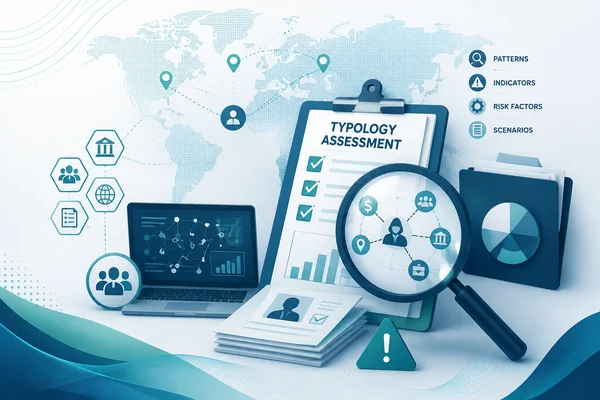
A Typology Assessment helps you understand what those patterns could look like in your business. It connects known financial crime methods with your customers, products, payment routes and day-to-day transaction activity.
Vertex Compliance does not start with a generic list and assume every scenario applies. The assessment is shaped around the way your business actually works and the activity your teams normally see.
You come away knowing which typologies deserve attention, what signs to watch for and whether your current monitoring is likely to pick them up.
Our Approach
We understand your business first, then match relevant typologies to your existing monitoring and controls.
Understand the Business
We begin with how the business works day to day. That means understanding your customers, products, services, transaction flows, payment routes, countries and delivery channels. We also get a sense of the activity your team would normally expect to see. That context matters. Without it, an unusual pattern can easily be mistaken for ordinary customer behaviour — or the other way around.
Find Relevant Typologies
Next, we work out which financial crime methods could realistically appear in your business. We do not load the assessment with every known typology. Instead, the focus stays on patterns that make sense for your customers, products and transaction activity. That could include unusual fund movements, connected-party activity, sudden behavioural changes or other activity that does not fit the expected profile.
Check Your Controls
Once the relevant typologies are clear, we compare them with the controls already in place. Monitoring scenarios, thresholds, alerts and customer reviews are checked to see what they are actually designed to catch. This often shows where an important behaviour has been missed, where a rule is too broad or where an existing scenario is producing alerts that add little value.
Prioritise the Changes
The last step is deciding what needs attention first. You get practical actions based on what the assessment finds. That might mean introducing a new scenario, changing an existing threshold, improving escalation or giving staff clearer red flags to work with. The result is a more focused monitoring process and a clear idea of what to improve next.
Who Is a Typology Assessment For?
Banks and Financial Institutions
Designated Non-Financial Businesses and Professions
Virtual Asset Service Providers
Fintech, Payment and Remittance Businesses
Ideal for businesses that need to identify emerging ML/TF patterns and understand how relevant typologies may affect their risk exposure.
Meet the Experts

Vasantha Madan Mohan
Managing Director

Sridhar Rajam
Associate Partner

Arjun Mohan
Director – Sales & Marketing