
Call us today +971 - 56411 3575 or +971 - 58914 9282 | Email: info@vertexcompliance.com

Compliance Training & Development UAE

Give your employees the right compliance knowledge for their roles, the risks they face, and the decisions they make at work.

Enquire About Training

    Make Compliance Training Relevant to the Job

    Training works better when employees can connect it to situations they actually encounter. A compliance officer may need a detailed understanding of AML requirements. A cashier needs to know how to handle suspicious currency. Someone working with customers may need more guidance on fraud, consumer protection, or when to raise a concern. Giving all of them exactly the same training does not make much sense.
    Vertex Compliance develops training around the work your employees do and the risks that come with it. You can adjust the subject, level of detail, and examples for different departments and levels of responsibility.
    We provide training across AML, fraud, IT security, consumer protection, risk management, FATCA/CRS, counterfeit currency detection, and professional development. Whether you need a session for one team or training across several departments, we can help you put together a programme that fits your business.
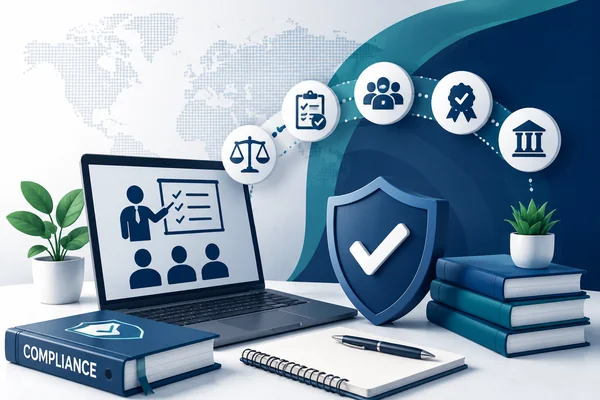
    Make Compliance Training Relevant to the Job

    Our Training & Development Services

    Choose the areas your team needs to understand better and build the training around their day-to-day responsibilities.

    Businesses We Support

    We work with regulated and higher-risk businesses where employees need a clear understanding of compliance, financial crime, fraud, security, customer, and operational risks.

    Banks & Financial Institutions

    Banks usually need different training for their various teams. Frontline staff may need support with AML warning signs, fraud, customer treatment, or escalation, while compliance professionals may require deeper sessions on AML/CFT, FATCA/CRS, risk, and regulatory developments. We can shape the subject and level of detail around the people attending and the responsibilities they hold.

    Exchange Houses

    Employees in exchange houses handle cash, customers, remittances, and a high volume of transactions. That makes areas such as AML, fraud, counterfeit currency, and consumer protection particularly important. Training can also show employees when additional checks are needed, what signs should raise concern, and when a transaction or customer needs to be referred to the compliance team.

    Fintech & Payment Companies

    Fintech and payment businesses often face compliance, technology, fraud, and customer risks at the same time. Their teams may also grow quickly, which makes consistent training important. We can provide AML, fraud, IT security, consumer protection, risk management, and role-based training for compliance, operations, customer support, management, and other employees involved in the service.

    Insurance Companies

    Insurance employees may work with customers, payments, claims, complaints, documents, and sensitive personal information. Each of those areas can carry different risks. Training can focus on AML, fraud, consumer protection, risk management, information security, or the reporting responsibilities attached to a particular role. The content can also be adjusted for customer-facing staff, operational teams, managers, and compliance professionals.

    Virtual Asset Businesses

    Virtual asset businesses can face changing transaction patterns, new fraud methods, technology risks, and customers operating across different jurisdictions. Staff need to understand how these issues affect their own work. Training may cover AML/CFT, fraud awareness, IT security, customer risk, escalation, and risk management. The level of detail can vary between compliance teams, customer-facing employees, operations, and management.

    Real Estate Businesses

    Property transactions can involve large payments, overseas customers, companies, beneficial owners, and unusual funding arrangements. Brokers, agents, managers, and compliance staff need to know when something requires more attention. Training can cover AML risks, customer checks, beneficial ownership, fraud indicators, suspicious activity, and escalation. Keep sessions focused on the situations that employees are most likely to encounter during property transactions.

    Precious Metals & Stones Dealers

    Businesses dealing in precious metals and stones may handle high-value goods, cash payments, and customers carrying out large or unusual transactions. Employees should be aware of the warning signs that warrant further investigation. Training may cover AML, customer due diligence, fraud, counterfeit currency where relevant, suspicious activity, and internal reporting. The content can be built around the types of transactions and customers the business normally handles.

    Accounting, Legal & Company Service Providers

    These firms may deal with company structures, beneficial owners, client money, customer documents, and sensitive business information. That creates a need for training that goes beyond general awareness. We can cover AML, fraud, customer due diligence, role-based responsibilities, escalation, and ongoing professional development. The training can also reflect the type of work the firm provides and the risks connected with its clients.

    Frequently Asked Questions

    Yes. The subject and level of detail You can adjust the subject and level of detail based on your industry, employee roles, business activities, risks, and compliance requirements.
    Usually, no. A compliance officer may need much more detail than someone working at the front desk or handling customer transactions. Role-based training allows each group to focus on the parts that actually matter to their work.
    We provide CPD programmes, role-based training, AML training, anti-fraud training, IT security training, consumer protection training, counterfeit currency detection training, risk management training, and FATCA/CRS training.
    Yes. Training can be arranged for one department or for several teams across the organisation. The content can also be different for each group if their responsibilities are not the same.
    Frontline employees may need AML training if they engage in activities such as dealing with customers, onboarding, transactions, or payments, where there is a risk of financial crime. Their training can focus on warning signs, basic checks, and escalation rather than the more technical areas handled by a compliance team.
    Yes. If there is one area where employees need more guidance, the training can focus on that subject without adding unrelated topics.
    Look first at what each team does, the risks connected to those activities, and the compliance responsibilities they already have. We can discuss your current training, employee roles, and any gaps you have noticed to help identify which areas should be covered first.