Your payment app is gaining customers. A distribution partner wants to bring in more users. The product team has a feature ready, and investors are asking when you will enter the next market.
Then someone asks whether the onboarding process can handle twice as many applications.
Nobody has tested it.
Growth has a way of exposing problems that were easier to manage with fewer customers. Manual checks become backlogs. Payment differences take longer to investigate. Employees start making exceptions because the existing process cannot keep up.
Fintech compliance solutions should help you identify these weaknesses before expansion adds pressure. The starting point is a practical review of how your business operates today and what will change when it grows.
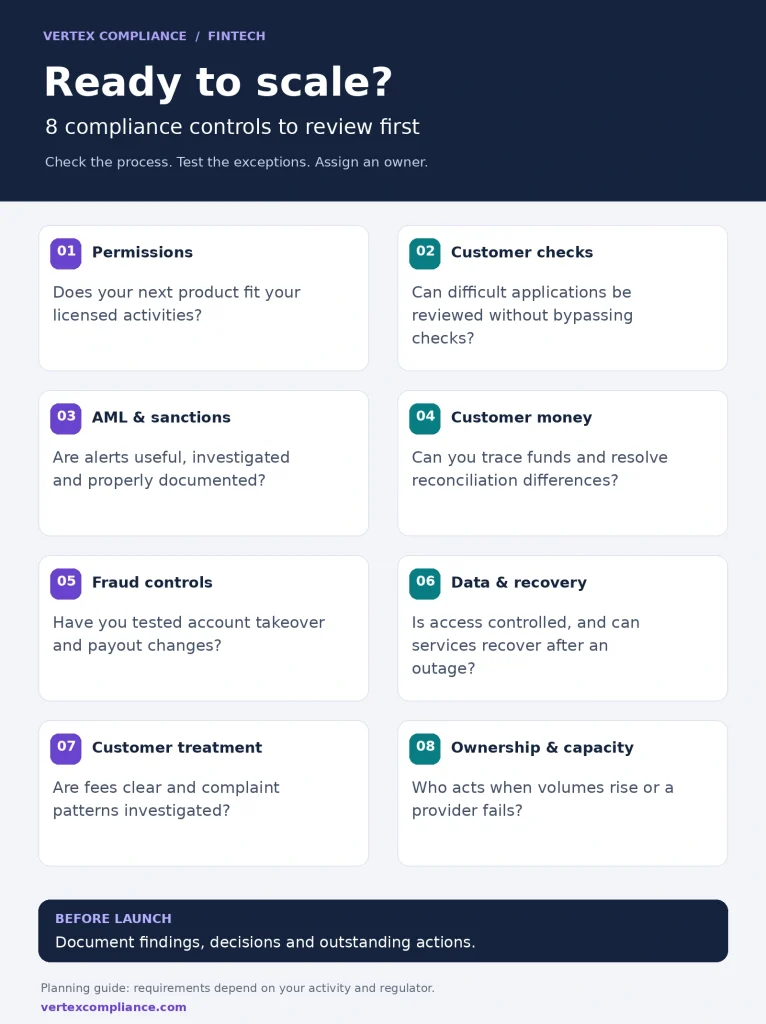
Controls to Review before Scaling
A digital wallet, payment gateway and lending platform do not have identical compliance needs. Your controls should reflect your activities, customers, payment flows and regulatory obligations.
For a UAE fintech, begin by confirming the requirements that apply to its licence and regulator. Then review customer onboarding, financial crime controls, customer money, technology and consumer protection.
Bring product, operations, finance and compliance into the discussion. Each team sees different problems. A customer complaint might reveal a settlement issue that never appears in a compliance report.
Use the following checks to guide that conversation.
1. Confirm Your Permissions Before Expanding
A new feature can change your regulatory position.
Perhaps your platform currently connects buyers and sellers but will soon hold customer balances. Or you process domestic payments and want to introduce overseas transfers.
Have the proposed activity assessed before committing to a launch date. The CBUAE’s retail payment framework distinguishes between different services, so calling a product a “payments app” does not establish which permissions it needs. rulebook.centralbank.ae
Write down who receives funds, who holds them and who executes transactions. Include every partner involved.
Do not assume a partner’s licence automatically permits your own activities. Get clarity on each business’s responsibilities and any approvals required for the proposed arrangement.
2. Review KYC and Customer Onboarding
Most onboarding demonstrations show a customer with clear documents and straightforward information.
Actual applications are messier.
Names differ between records. An identity check fails. A business customer has several ownership layers. Someone submits another application after being rejected.
Follow a sample of difficult cases through your Know Your Customer process. Can reviewers see why a check failed? Can they request more information? Is the reason for approving an exception recorded?
Check what incomplete applications allow customers to do. Any access before outstanding checks are resolved needs to be permitted and appropriately restricted.
Also measure the queue. If applications already wait several days for manual review, a marketing campaign could turn a manageable delay into a serious backlog.
3. Review AML Monitoring and Sanctions Screening
A monitoring rule can be switched on without producing useful results.
A rule focused on individual large transfers, for example, may miss suspicious activity involving several smaller payments. Another might produce so many alerts that investigators struggle to identify urgent cases.
Review AML monitoring against your products, customer groups and payment routes. Ask whether the information investigators receive is sufficient to understand an alert.
Sanctions screening needs attention when relevant lists, customer details or connected parties change.
Check what happens after a potential match. Who investigates? Who can stop activity? What evidence supports the decision?
The CBUAE’s payments guidance discusses financial crime risks associated with payment products and services. Use those risks to challenge whether your controls fit your actual business. rulebook.centralbank.ae
4. Trace Customer Funds and Reconciliations
Pick a payment and follow it from receipt to settlement.
Then try a refund, a failed transaction and a payment received near the daily reporting cut-off. Can finance and operations explain where the money is at each stage?
Where safeguarding requirements apply, check that your arrangements meet the rules for your activity.
Reconciliation deserves particular attention. Who investigates differences between customer balances and underlying records? How are unresolved amounts tracked? Who takes over when the usual employee is absent?
Avoid accepting “the system handles it” as a complete answer. Ask someone to demonstrate the process and explain a recent mismatch.
Higher transaction volumes will make unexplained differences harder to investigate.
5. Test Your Fintech Fraud Controls
Fraud prevention needs its own review alongside AML compliance.
Consider account takeover, stolen credentials, fake merchants, refund abuse and changes to payout details.
Test realistic scenarios in a controlled environment. What happens when a customer resets a password and immediately changes their bank account? Can repeated failed payment attempts continue without review?
Check employee permissions too. Support staff need enough access to resolve problems, but sensitive actions should have appropriate restrictions and records.
Review legitimate customers affected by fraud controls. If people are repeatedly blocked without a clear reason, complaints will rise—and staff may begin finding ways around the process.
Investigate both missed fraud and unnecessary restrictions.
6. Review Data Security and Business Continuity
Start with access to customer information.
Who can view identity documents, payment records and support conversations? Include contractors, service providers and employees who have changed roles.
Check whether access is removed promptly and whether sensitive actions can be traced.
Then test a service disruption. If your screening provider becomes unavailable, does onboarding pause, queue applications or follow an approved contingency process?
Someone needs authority to choose the response.
Ask for evidence that backups can be restored. A successful backup notification does not prove your team can recover the service and its records.
Check that recovery plans reflect dependencies between systems, rather than treating each supplier separately.
7. Check Consumer Protection and Complaints
Read the customer journey on a phone.
Are fees visible before confirmation? Are payment limits understandable? Does the refund explanation match what happens in practice?
Pay attention to messages shown when something goes wrong. “Transaction unsuccessful” gives customers little help if money has left their account.
Complaints can expose problems before management reports do. Several customers describing delayed refunds may point to a broken handoff between support and finance.
Assign someone to investigate recurring issues and report findings to product and operations.
Customers reporting suspected fraud also need a clear route to help. They should not have to contact several departments while an account remains exposed.
8. Assign Owners and Check Team Capacity
A control needs someone who can act when it identifies a problem.
Name the owner, the person authorised to approve changes and the backup contact.
Then look at workload. If alerts double, how many additional reviews can your team realistically complete? If a provider misses a deadline, who follows up?
Before launch, agree which findings must be resolved and which can be managed through documented restrictions.
Track overdue actions, unresolved cases and repeated errors. These show where work is getting stuck.
A policy update may be complete while the process it describes remains broken. Check what employees actually do before marking an issue closed.
Review Your Fintech Compliance Solutions with Vertex Compliance
Before scaling, your team should be able to explain its main risks, demonstrate its controls and identify who handles exceptions.
If those answers are unclear, resolve the gaps while changes are still manageable. Waiting until customer numbers rise usually means more records to review and more people affected.
Vertex Compliance’s fintech compliance solutions draw on its advisory services for fintech setup, policy drafting, anti-fraud frameworks, data protection and consumer protection.
Discuss Your Fintech Compliance Needs to identify support relevant to your UAE business, its activities and expansion plans.
FAQs
1. When should a fintech review its compliance controls?
Before launching a product, entering a market or significantly increasing transaction capacity. Repeated complaints, incidents and growing review backlogs are also reasons to reassess existing controls.
2. Does compliance software make a fintech compliant?
Software supports checks and monitoring. Your team still needs to configure it correctly, investigate exceptions and assess whether its results remain useful as products and customers change.
3. Which compliance controls should we review first?
Confirm that proposed activities fit your permissions. Then prioritise weaknesses affecting customer funds, financial crime prevention and service continuity, based on the risks of your planned expansion.
4. Can a fintech outsource compliance tasks?
Some tasks may be outsourced where permitted. Check applicable conditions, retain oversight and agree how the provider will escalate concerns, protect information and demonstrate completed work.
5. What records should a compliance review produce?
Keep the scope, test results, findings and corrective actions. Record decisions about outstanding risks, who approved them, any temporary restrictions and when those decisions must be reviewed.