
An AML service proposal can look thorough and still leave you with unanswered questions.
It mentions risk assessments, customer checks, monitoring, and training. Everything appears to be there. Then a difficult customer file arrives, and you discover that reviewing complex ownership sits outside the agreement. The provider can raise an alert, but your team must investigate it. Reporting support means preparing notes, not submitting a report.
These details matter when you’re choosing AML compliance services. You need to know how the arrangement will work on an ordinary Tuesday, with a growing case queue and someone waiting for approval.
Before signing, work through the tasks your team needs help with. The following areas are a good place to start.
First, Be Clear About What You Need
AML compliance services help businesses identify money laundering risks, put controls in place, and carry out applicable compliance duties. The work can range from reviewing a few overdue customer files to helping rebuild an entire program.
Your starting point makes a difference.
An established business may have workable policies but too few people to investigate alerts. A newer firm may need help deciding which checks belong in its onboarding process. Another team might be preparing for an inspection and struggling to retrieve supporting records.
Tell the provider where work gets stuck. Be specific about the backlog, the recurring questions, and the decisions staff are unsure about. That conversation is more useful than choosing a package because it has the longest list of features.
A Financial Crime Risk Assessment With Reasons Behind It
A financial crime risk assessment helps you understand where exposure comes from and whether your controls are doing enough.
It usually examines customers, ownership structures, products, countries, transaction activity, and the ways people access your services. Relevant terrorist financing, proliferation financing, and sanctions risks also need consideration.
The assessment needs to reflect your business as it operates today.
Perhaps you’ve started accepting customers from another market. Perhaps a payment service now allows transfers that weren’t possible a year ago. Those changes can make an older assessment incomplete.
Pay attention to the reasoning behind the ratings. If a customer category is marked high risk, your team needs to understand why. Otherwise, it’s difficult to decide what additional checks would help.
You should receive a documented method, supporting evidence, and a clear account of the risks that remain after controls.
An AML Gap Analysis You Can Work From
An AML gap analysis checks whether your arrangements meet applicable requirements and whether the controls work as intended.
Reading the manual is part of that job. Looking at actual files is another.
For instance, your policy may require staff to identify beneficial owners. A sample of customer records might reveal that they’ve collected company certificates without establishing who ultimately owns the business.
That finding gives you something concrete to address.
The report needs to explain what went wrong, where the evidence came from, and which requirement or control is affected. It also needs a practical recommendation.
“Improve due diligence” leaves too much open. Identifying the missing check, assigning an owner, and setting a completion date makes the work manageable.
Agree on how fixes will be tested. A task marked complete may still leave the underlying problem unresolved.
Customer Checks That Go Beyond Collecting Documents
A folder full of documents doesn’t necessarily mean you understand the customer.
Take a company owned through several other companies. You may have registration papers for each entity and still be unable to explain who ultimately controls it.
Customer due diligence support needs to deal with these situations. Alongside identity verification, it may include beneficial ownership checks, customer risk ratings, understanding the relationship’s purpose, and keeping information current.
Higher-risk cases may need enhanced due diligence. Depending on the circumstances and applicable rules, that can involve further information about source of funds or source of wealth.
Find out what happens when documents conflict or information cannot be verified. Who investigates? Who approves the next step?
Those decisions shouldn’t depend on which colleague happens to be available that day.
Screening That Helps Staff Reach a Decision
Anyone who has reviewed screening matches knows how quickly a common name can create extra work.
The system flags a possible match. The available details are limited. An analyst has to decide whether the result relates to the customer or someone else.
The service needs a consistent review process for those cases.
Screening may address applicable sanctions lists, politically exposed persons, and relevant adverse media. Each calls for an appropriate assessment. A politically exposed person is not automatically a prohibited customer, and a news mention needs to be checked for relevance and credibility.
Clarify how lists are updated and when existing customers are screened again.
Look at the review notes too. Someone picking up the file later should be able to follow the conclusion without starting from scratch.
Transaction Monitoring Suited to Your Customers
A transaction pattern only makes sense when you know something about the account.
Frequent small payments might be expected for a merchant. The same activity could be unusual for a customer whose account normally receives one monthly payment.
Monitoring needs to account for that context.
Check which scenarios the provider uses, what data feeds them, and how thresholds are tested. Rules borrowed from a different business may create unnecessary alerts or miss activity your team needs to examine.
Then follow an alert through the process. Who reviews it? How are urgent cases identified? What happens when the queue builds up?
Lower alert numbers may be welcome, but they don’t establish that monitoring has improved. Testing needs to show whether relevant activity still gets detected and reviewed.
Clear Investigation and Reporting Responsibilities
An analyst reviewing unusual activity needs access to the full picture.
That might include customer documents, ownership information, transaction history, previous alerts, and explanations already obtained. When records are scattered across teams, a straightforward review can become a series of follow-up emails.
Set out who gathers the evidence and who assesses it. Specify who decides whether a suspicious transaction or activity report is required.
Reporting support needs careful definition. Preparing a case summary, reviewing a draft, and submitting a filing are different tasks.
The arrangement also needs to address applicable deadlines, confidentiality, and restrictions on tipping off customers.
For closed cases, keep the reasoning. A note saying “reviewed—no concern” won’t help much when someone asks what was examined and why the case was closed.
Procedures Staff Can Use, With Training to Match
A procedure becomes useful when it answers the question in front of the employee.
What if the ownership information is inconsistent? What if an urgent screening match arrives while the compliance officer is away? Who can approve a higher-risk relationship?
Staff need clear steps and named responsibilities.
Training should use examples drawn from the work each team handles. Onboarding employees need practice spotting missing information. Investigators need to weigh evidence. Managers need to understand unresolved risks and resource needs.
Attendance records matter, but check understanding as well.
Independent testing then looks at what happens in practice. It may involve sampling customer files, tracing alerts, reviewing reporting decisions, and testing corrective actions. Where one provider designs and reviews the program, examine how independence and conflicts are managed.
Don’t Overlook AML Software Security Risks
AML systems contain information you would not want exposed: identity documents, transaction records, ownership details, and investigation notes.
AML software security risks therefore belong in the service discussion from the beginning.
Review access permissions, encryption, audit logs, backups, incident response, subcontractors, and data location. Check how access is removed when someone leaves and what happens to your information when the contract ends.
Also check whether the system receives complete, accurate data. A missing transaction feed can weaken monitoring even when the software appears to be running normally.
For digital banking compliance, follow a customer through remote onboarding, screening, monitoring, and reporting. Fintech compliance solutions need to fit the product’s payment routes and speed, with clear arrangements for cases requiring human judgment.
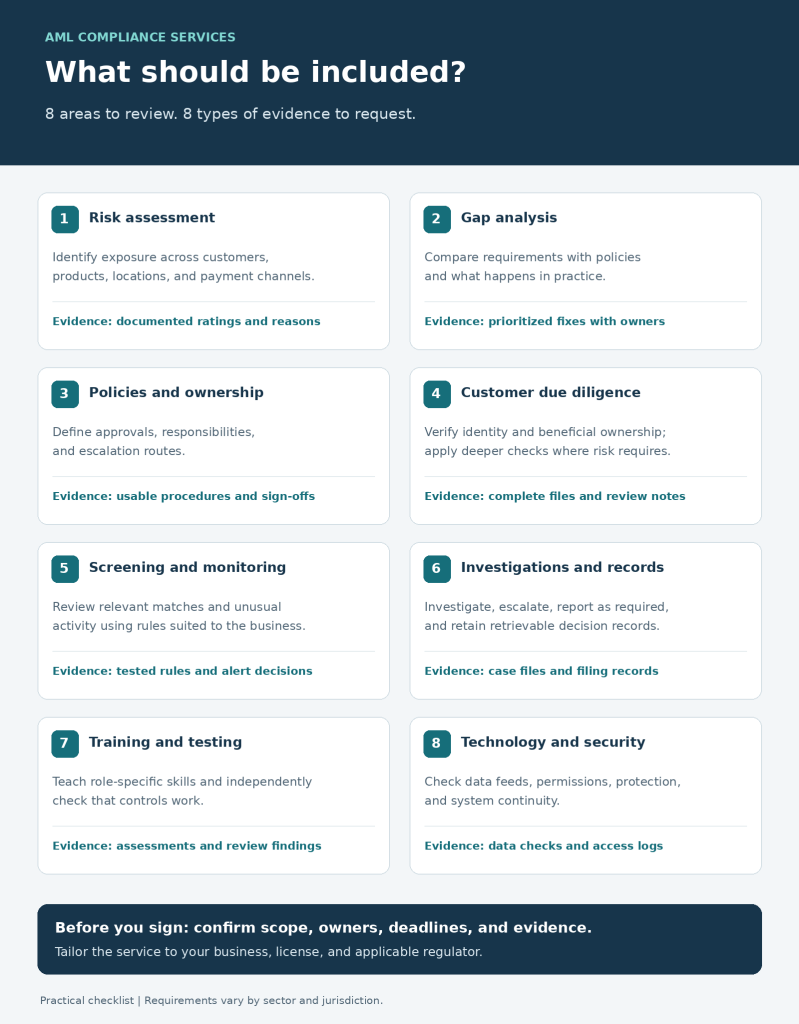
Use this checklist to compare service proposals and identify missing deliverables.
What UAE and Dubai Businesses Need to Check
When comparing AML compliance services UAE providers offer, establish which framework applies to your business activity, license, and supervisory authority.
The UAE introduced Federal Decree-Law No. 10 of 2025 and its executive regulations. The DFSA’s updated AML and Glossary Modules took effect on March 2, 2026. The proposed work needs to reflect the requirements applicable to your firm. www.dfsa.ae
For AML compliance Dubai businesses require, check the provider’s experience with your regulator. Being based in Dubai does not automatically put a business under the DFSA; its financial services jurisdiction is the DIFC. www.dfsa.ae
Request a written connection between those requirements and the services included.
How Vertex Compliance Can Support Your Team
You may need help clearing overdue customer reviews. Or your team may be preparing for an AML inspection while keeping up with daily work.
At Vertex Compliance, our compliance outsourcing services support the areas where you need extra capacity. That includes KYC reviews, regulatory data preparation, inspection readiness, and ongoing compliance work. You can get help with specific tasks without outsourcing your entire compliance function.
Start with the issue taking up too much of your team’s time. We’ll discuss the support needed around your business, regulator, and existing resources.
Frequently Asked Questions
1. What should AML compliance services include?
You’ll usually need help with risk assessments, customer checks, screening, transaction monitoring, reporting, training, and independent testing. The details matter, though. Will the provider investigate alerts or just send them to your team? Will they review difficult ownership cases? Get those answers before agreeing to the scope.
2. What is the difference between an AML gap analysis and a financial crime risk assessment?
A financial crime risk assessment looks at where your business is exposed. An AML gap analysis checks what’s missing or isn’t working in your program. Say you deal with companies that have complicated ownership structures. The risk assessment examines that exposure; the gap analysis checks whether your team is actually identifying the owners properly.
3. How should businesses choose an AML compliance services provider in the UAE?
Find out whether they understand your industry and the regulator you report to. Then bring up a problem you’re dealing with. How would they resolve an incomplete customer file, for example? Their answer will tell you more than a sales presentation. Check a sample deliverable, the fees, and any exclusions before signing.
4. Can compliance outsourcing services replace an internal compliance team?
Outsourcing can take work off your team’s plate, but you still need someone in the business to oversee it. Who will approve a difficult case or follow up when work is overdue? Decide that early. You’ll also need to check whether your regulator allows the particular role or task to be outsourced.
5. What AML software security risks should compliance teams review?
Check who has access to customer files and whether they need that access. Can they download sensitive records? Is their access removed when they leave? Ask about outages, data breaches, and recovery too. Don’t overlook missing payment feeds—a system can look fine on screen while transactions never reach its monitoring rules.