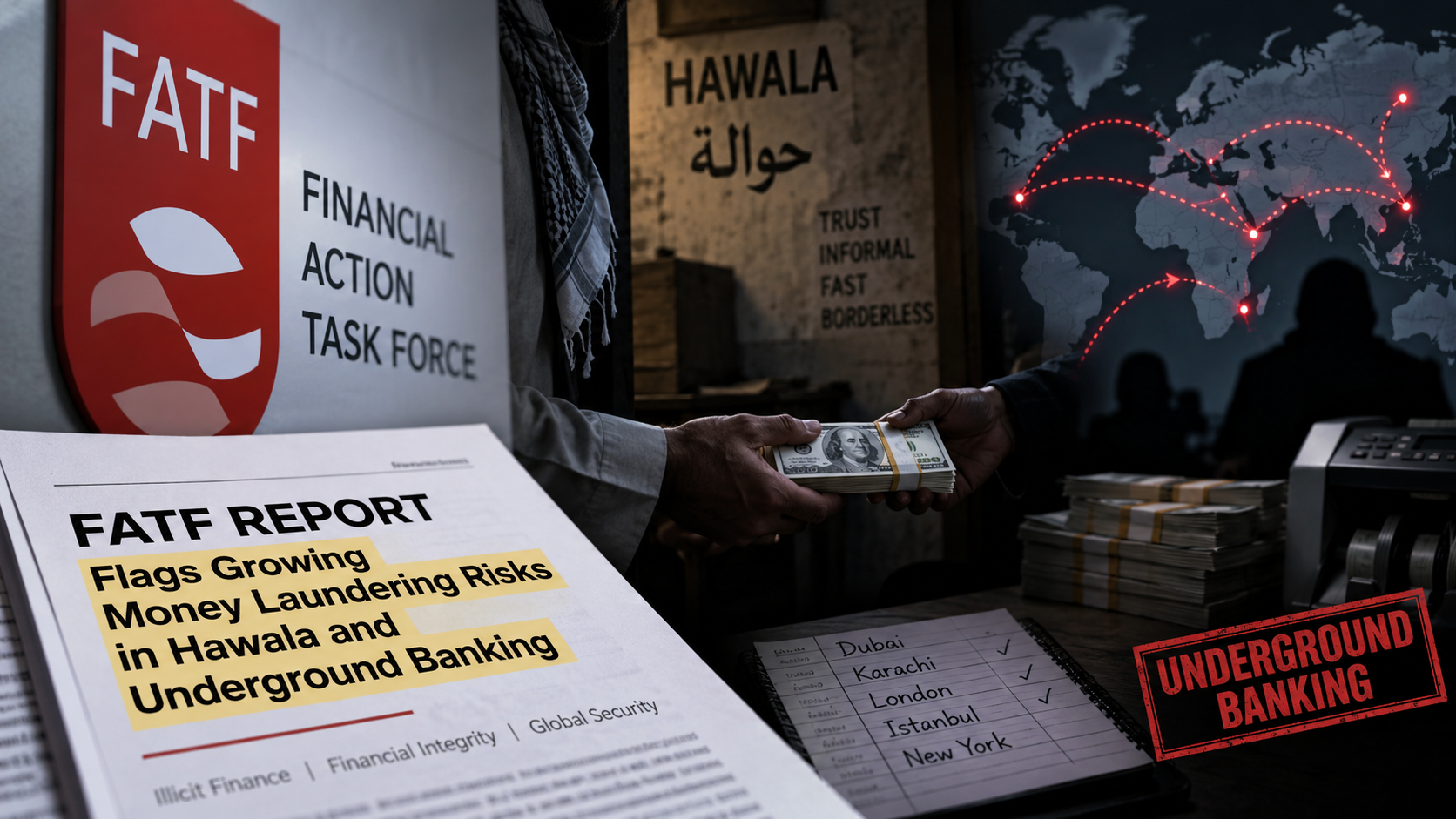
Hawala and other informal value transfer services can meet a genuine need, particularly where access to conventional banking is limited. A new report from the Financial Action Task Force (FATF) examines a different side of these systems: how professional money launderers use them to move criminal proceeds, often across borders and alongside regulated financial services.
FATF Recommendation 14 calls on countries to license or register money or value transfer service providers and monitor their compliance. It also calls for action against providers operating without the required licence or registration.
FATF’s findings point to a problem that goes well beyond cash changing hands outside a bank. In some cases reviewed for the report, more than €500 million was laundered through underground banking and hawala-based schemes in just a few months. More than 80% of jurisdictions that responded identified these systems as a principal channel or technique used in professional money laundering.
How the Networks Operate
Professional money launderers provide a service to criminals: they arrange for proceeds to be received, moved and made available elsewhere while obscuring the link to the original crime. FATF describes increasingly organised networks capable of handling large volumes at speed and operating across borders.
These arrangements can touch legitimate businesses and regulated accounts. FATF identifies bank accounts, payment providers, fintech platforms, virtual IBANs, prepaid cards and virtual asset wallets as possible entry or exit points. It also notes the involvement of some professional intermediaries, including company formation agents, real estate agents and casino or junket operators. That does not make activity involving any one of these services suspicious on its own. The concern is how several services may be used together to conceal who is paying, who ultimately receives value and why.
Hawala is Becoming more Digital
FATF reports that nearly 70% of respondents identified the use of new technology in these networks. Operators may coordinate through encrypted messaging, accept funds through mobile wallets or instant payments, and settle balances using virtual assets, including stablecoins. FATF also describes purpose-built hawala apps and the use of AI-based tools.
The practical lesson for compliance teams is to follow the movement of value across channels. A transaction may look ordinary when viewed in a single account. Its purpose may be less clear when the customer’s stated business, counterparties, payment pattern and subsequent transfers are considered together.
What Compliance Teams should Review
The report is a risk assessment and investigation resource; it does not create a new compliance obligation by itself. Firms should apply their own jurisdiction’s laws and supervisory requirements. It does, however, give teams a reason to check whether their existing controls can identify activity linked to informal transfer networks.
Useful questions include:
- Can the firm establish the customer’s business purpose and expected payment activity?
- Are third-party payments or cross-border transfers consistent with that explanation?
- Do monitoring rules connect activity across accounts, payment products and virtual asset exposure where the firm has that visibility?
- Can investigators explain the source of funds, the intended recipient and the reason for the transaction?
- Are staff trained to escalate a pattern of unusual activity, rather than relying on a single indicator?
These are review prompts, not a standalone list of FATF-mandated checks. They should be adapted to the firm’s products, customers and local rules.
A Balanced Response Matters
FATF is careful to distinguish legitimate use of hawala and similar services from criminal misuse. It calls for stronger detection and enforcement alongside legal clarity and proportionate financial inclusion. Treating every informal transfer as illicit would miss that distinction and could push legitimate users further from regulated services.
For regulated firms, the immediate task is practical: revisit risk assessments, test whether monitoring reflects the ways value now moves between formal and informal channels, and make sure unusual patterns can be investigated and explained. The report shows how quickly professional laundering networks can adapt; compliance controls need to keep pace with the activity they actually see.