
Call us today +971 - 56411 3575 or +971 - 58914 9282 | Email: info@vertexcompliance.com

What Should AML Compliance Services Include? A Guide for Compliance Teams

AML Compliance Services

An AML service proposal can look thorough and still leave you with unanswered questions.

It mentions risk assessments, customer checks, monitoring, and training. Everything appears to be there. Then a difficult customer file arrives, and you discover that reviewing complex ownership sits outside the agreement. The provider can raise an alert, but your team must investigate it. Reporting support means preparing notes, not submitting a report.

These details matter when you’re choosing AML compliance services. You need to know how the arrangement will work on an ordinary Tuesday, with a growing case queue and someone waiting for approval.

Before signing, work through the tasks your team needs help with. The following areas are a good place to start.

First, Be Clear About What You Need

AML compliance services help businesses identify money laundering risks, put controls in place, and carry out applicable compliance duties. The work can range from reviewing a few overdue customer files to helping rebuild an entire program.

Your starting point makes a difference.

An established business may have workable policies but too few people to investigate alerts. A newer firm may need help deciding which checks belong in its onboarding process. Another team might be preparing for an inspection and struggling to retrieve supporting records.

Tell the provider where work gets stuck. Be specific about the backlog, the recurring questions, and the decisions staff are unsure about. That conversation is more useful than choosing a package because it has the longest list of features.

A Financial Crime Risk Assessment With Reasons Behind It

A financial crime risk assessment helps you understand where exposure comes from and whether your controls are doing enough.

It usually examines customers, ownership structures, products, countries, transaction activity, and the ways people access your services. Relevant terrorist financing, proliferation financing, and sanctions risks also need consideration.

The assessment needs to reflect your business as it operates today.

Perhaps you’ve started accepting customers from another market. Perhaps a payment service now allows transfers that weren’t possible a year ago. Those changes can make an older assessment incomplete.

Pay attention to the reasoning behind the ratings. If a customer category is marked high risk, your team needs to understand why. Otherwise, it’s difficult to decide what additional checks would help.

You should receive a documented method, supporting evidence, and a clear account of the risks that remain after controls.

An AML Gap Analysis You Can Work From

An AML gap analysis checks whether your arrangements meet applicable requirements and whether the controls work as intended.

Reading the manual is part of that job. Looking at actual files is another.

For instance, your policy may require staff to identify beneficial owners. A sample of customer records might reveal that they’ve collected company certificates without establishing who ultimately owns the business.

That finding gives you something concrete to address.

The report needs to explain what went wrong, where the evidence came from, and which requirement or control is affected. It also needs a practical recommendation.

“Improve due diligence” leaves too much open. Identifying the missing check, assigning an owner, and setting a completion date makes the work manageable.

Agree on how fixes will be tested. A task marked complete may still leave the underlying problem unresolved.

Customer Checks That Go Beyond Collecting Documents

A folder full of documents doesn’t necessarily mean you understand the customer.

Take a company owned through several other companies. You may have registration papers for each entity and still be unable to explain who ultimately controls it.

Customer due diligence support needs to deal with these situations. Alongside identity verification, it may include beneficial ownership checks, customer risk ratings, understanding the relationship’s purpose, and keeping information current.

Higher-risk cases may need enhanced due diligence. Depending on the circumstances and applicable rules, that can involve further information about source of funds or source of wealth.

Find out what happens when documents conflict or information cannot be verified. Who investigates? Who approves the next step?

Those decisions shouldn’t depend on which colleague happens to be available that day.

Screening That Helps Staff Reach a Decision

Anyone who has reviewed screening matches knows how quickly a common name can create extra work.

The system flags a possible match. The available details are limited. An analyst has to decide whether the result relates to the customer or someone else.

The service needs a consistent review process for those cases.

Screening may address applicable sanctions lists, politically exposed persons, and relevant adverse media. Each calls for an appropriate assessment. A politically exposed person is not automatically a prohibited customer, and a news mention needs to be checked for relevance and credibility.

Clarify how lists are updated and when existing customers are screened again.

Look at the review notes too. Someone picking up the file later should be able to follow the conclusion without starting from scratch.

Transaction Monitoring Suited to Your Customers

A transaction pattern only makes sense when you know something about the account.

Frequent small payments might be expected for a merchant. The same activity could be unusual for a customer whose account normally receives one monthly payment.

Monitoring needs to account for that context.

Check which scenarios the provider uses, what data feeds them, and how thresholds are tested. Rules borrowed from a different business may create unnecessary alerts or miss activity your team needs to examine.

Then follow an alert through the process. Who reviews it? How are urgent cases identified? What happens when the queue builds up?

Lower alert numbers may be welcome, but they don’t establish that monitoring has improved. Testing needs to show whether relevant activity still gets detected and reviewed.

Clear Investigation and Reporting Responsibilities

An analyst reviewing unusual activity needs access to the full picture.

That might include customer documents, ownership information, transaction history, previous alerts, and explanations already obtained. When records are scattered across teams, a straightforward review can become a series of follow-up emails.

Set out who gathers the evidence and who assesses it. Specify who decides whether a suspicious transaction or activity report is required.

Reporting support needs careful definition. Preparing a case summary, reviewing a draft, and submitting a filing are different tasks.

The arrangement also needs to address applicable deadlines, confidentiality, and restrictions on tipping off customers.

For closed cases, keep the reasoning. A note saying “reviewed—no concern” won’t help much when someone asks what was examined and why the case was closed.

Procedures Staff Can Use, With Training to Match

A procedure becomes useful when it answers the question in front of the employee.

What if the ownership information is inconsistent? What if an urgent screening match arrives while the compliance officer is away? Who can approve a higher-risk relationship?

Staff need clear steps and named responsibilities.

Training should use examples drawn from the work each team handles. Onboarding employees need practice spotting missing information. Investigators need to weigh evidence. Managers need to understand unresolved risks and resource needs.

Attendance records matter, but check understanding as well.

Independent testing then looks at what happens in practice. It may involve sampling customer files, tracing alerts, reviewing reporting decisions, and testing corrective actions. Where one provider designs and reviews the program, examine how independence and conflicts are managed.

Don’t Overlook AML Software Security Risks

AML systems contain information you would not want exposed: identity documents, transaction records, ownership details, and investigation notes.

AML software security risks therefore belong in the service discussion from the beginning.

Review access permissions, encryption, audit logs, backups, incident response, subcontractors, and data location. Check how access is removed when someone leaves and what happens to your information when the contract ends.

Also check whether the system receives complete, accurate data. A missing transaction feed can weaken monitoring even when the software appears to be running normally.

For digital banking compliance, follow a customer through remote onboarding, screening, monitoring, and reporting. Fintech compliance solutions need to fit the product’s payment routes and speed, with clear arrangements for cases requiring human judgment.
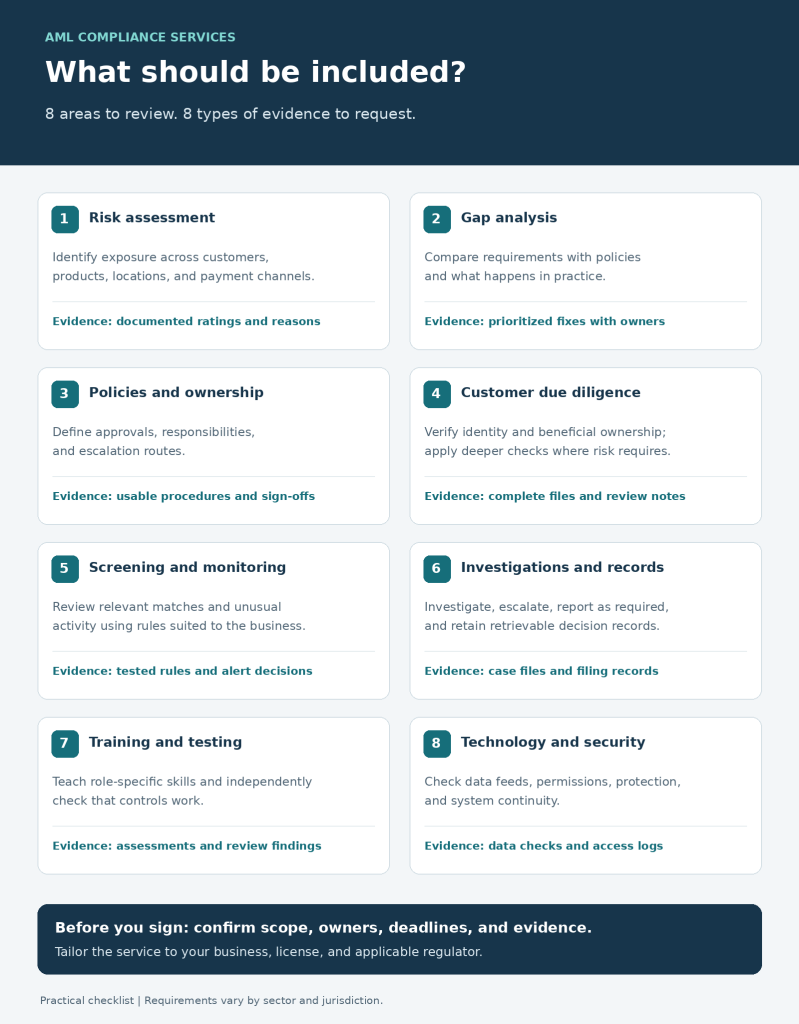
Use this checklist to compare service proposals and identify missing deliverables.

What UAE and Dubai Businesses Need to Check

When comparing AML compliance services UAE providers offer, establish which framework applies to your business activity, license, and supervisory authority.

The UAE introduced Federal Decree-Law No. 10 of 2025 and its executive regulations. The DFSA’s updated AML and Glossary Modules took effect on March 2, 2026. The proposed work needs to reflect the requirements applicable to your firm. www.dfsa.ae

For AML compliance Dubai businesses require, check the provider’s experience with your regulator. Being based in Dubai does not automatically put a business under the DFSA; its financial services jurisdiction is the DIFC. www.dfsa.ae

Request a written connection between those requirements and the services included.

How Vertex Compliance Can Support Your Team

You may need help clearing overdue customer reviews. Or your team may be preparing for an AML inspection while keeping up with daily work.

At Vertex Compliance, our compliance outsourcing services support the areas where you need extra capacity. That includes KYC reviews, regulatory data preparation, inspection readiness, and ongoing compliance work. You can get help with specific tasks without outsourcing your entire compliance function.

Start with the issue taking up too much of your team’s time. We’ll discuss the support needed around your business, regulator, and existing resources.

Frequently Asked Questions

1. What should AML compliance services include?

You’ll usually need help with risk assessments, customer checks, screening, transaction monitoring, reporting, training, and independent testing. The details matter, though. Will the provider investigate alerts or just send them to your team? Will they review difficult ownership cases? Get those answers before agreeing to the scope.

2. What is the difference between an AML gap analysis and a financial crime risk assessment?

A financial crime risk assessment looks at where your business is exposed. An AML gap analysis checks what’s missing or isn’t working in your program. Say you deal with companies that have complicated ownership structures. The risk assessment examines that exposure; the gap analysis checks whether your team is actually identifying the owners properly.

3. How should businesses choose an AML compliance services provider in the UAE?

Find out whether they understand your industry and the regulator you report to. Then bring up a problem you’re dealing with. How would they resolve an incomplete customer file, for example? Their answer will tell you more than a sales presentation. Check a sample deliverable, the fees, and any exclusions before signing.

4. Can compliance outsourcing services replace an internal compliance team?

Outsourcing can take work off your team’s plate, but you still need someone in the business to oversee it. Who will approve a difficult case or follow up when work is overdue? Decide that early. You’ll also need to check whether your regulator allows the particular role or task to be outsourced.

5. What AML software security risks should compliance teams review?

Check who has access to customer files and whether they need that access. Can they download sensitive records? Is their access removed when they leave? Ask about outages, data breaches, and recovery too. Don’t overlook missing payment feeds—a system can look fine on screen while transactions never reach its monitoring rules.

AML Compliance Services in the UAE: How to Choose the Right Support

AML Compliance Services in the UAE: How to Choose the Right Support

Suppose your business has an AML review coming up. You pull a few customer files to check whether everything is in order. One has an expired document. Another has a risk rating with no explanation. A third is missing an approval.

You now have two jobs: find out how far the problem goes and decide who will fix it.

This is often where the search for AML compliance services in the UAE begins. The business already has policies and people handling compliance. What it needs is help with something specific.

Before comparing providers, spend some time working out what that something is. Otherwise, you could pay for a broad review when you need help clearing a backlog, or pay for file updates without addressing the process that caused the backlog.

What Is Making You Look for Support?

Start with what has happened in your business.

Perhaps an internal review found incomplete customer records. Your compliance officer may be spending too much time chasing documents. You might have introduced a new service and need to revisit the risks involved.

These situations should lead to different conversations with a provider.

For a backlog, explain how many files are waiting and what needs to be checked. For recurring findings, share the earlier reports and the actions taken so far. For a business change, describe the new service, the customers involved and how transactions will work.

You do not need to diagnose everything before asking for help. You do need to give the provider enough information to make a sensible recommendation.

Choose the Service That Fits the Problem

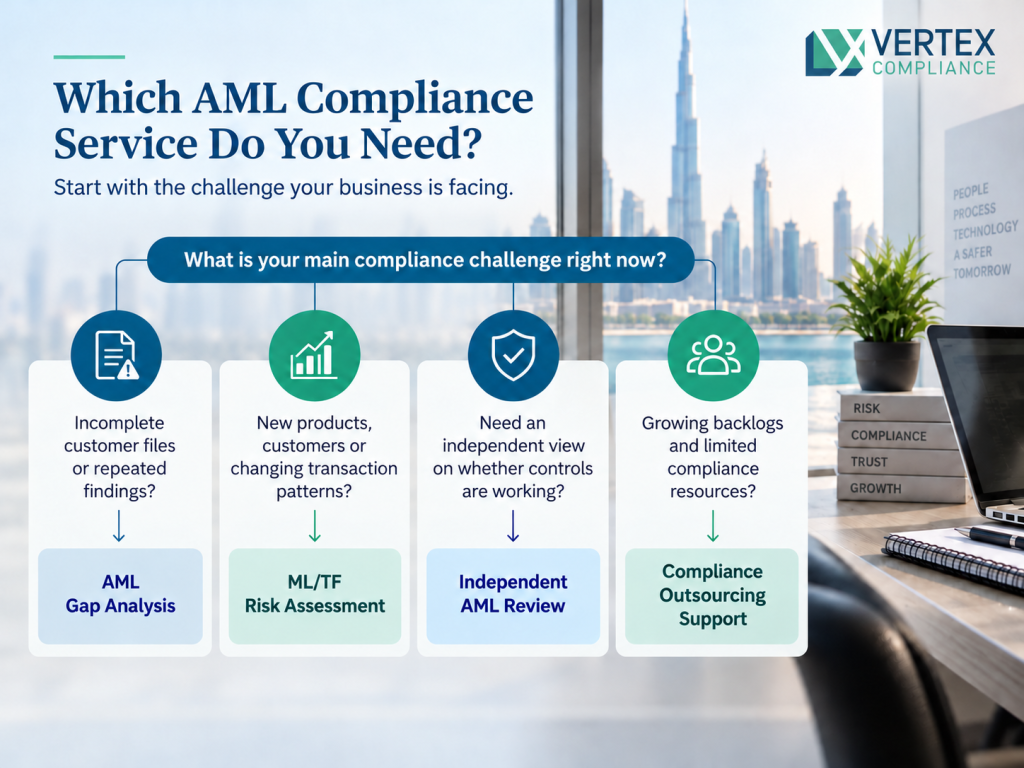
The names of AML services can sound similar. Ask what each engagement will examine and what you will learn from it.

When You Need AML Gap Analysis

An AML gap analysis looks at weaknesses in your existing framework and how it is used.

Consider a file that is missing approval for a high-risk customer. Finding the missing record is useful, but it leaves several questions open. Was approval given by email? Did someone miss the step? Was the customer allowed to transact before approval? Have other files been handled the same way?

Those questions help establish what needs fixing. The answer might be better record keeping, a change to the approval process or a wider review of customer files.

Discuss how much testing is included. Reading a policy will show what staff are expected to do. Examining records helps establish what they actually did.

When Your Risk Assessment Needs Attention

A business can change quite quickly while its risk assessment stays on the shelf.

You may be accepting different customers, handling larger transactions or offering a new payment channel. If the assessment still describes the old business, it may give your team a poor basis for deciding where to focus.

An AML risk assessment in the UAE should take account of your actual operations. Expect to provide information about customers, products, services, transaction activity, countries and the controls already in place.

Ask how the provider will handle missing information. That discussion matters because an assessment is only as useful as the information behind it.

When You Need an Independent Review

Sometimes management needs another view of how the AML programme is working.

An independent assessment may be appropriate when concerns extend across several processes or when earlier findings have not been resolved convincingly.

If the concern is narrow, a more focused engagement may be enough. For example, you may want specific checks on customer risk ratings or screening records.

Agree on what the engagement is intended to establish. Also, clarify the type of report being provided. An agreed-upon procedures engagement reports the factual results of specified checks rather than an overall audit opinion.

When Your Team Needs Help With the Workload

A growing pile of unfinished files may call for operational support.

Compliance outsourcing services can help with defined tasks, but the handover needs planning. Someone must explain the review criteria, answer questions and check completed work.

Suppose the provider finds a customer whose ownership information is unclear. Who requests the missing details? Who decides whether the relationship can continue? Who records the decision?

Settle those responsibilities before the work begins. Check any outsourcing restrictions or approval requirements that apply to your business as well.

Have a Proper Conversation Before Asking for a Price

It is difficult to compare fees when the work has not been defined.

Give each provider the same background information and ask for a written proposal. During the discussion, pay attention to the questions they ask.

Do they want to understand your customer base? Have they asked about previous findings? Do they know which authority supervises your business? Have they explained what information they will need?

A provider that understands the task should be able to describe its approach without hiding behind broad claims about expertise.

Relevant experience is worth checking too. Ask about work involving similar business activities or problems. An anonymised example can be helpful, provided it explains the approach and does not disclose a client’s information.

Read the Scope Carefully

The proposal should tell you what will be examined, how the work will be done and what you will receive.

Look closely at the sample size. A review of a small number of files is different from a review of the whole backlog. Neither is automatically wrong, but they serve different purposes.

Check whether the fee includes meetings to discuss findings, recommendations and a follow-up review. If you expect help making changes, confirm that it is included.

Also, read the exclusions. Work involving an additional system, another business unit or more files may carry an extra charge.

Before signing, you should be able to answer these questions:

  • What work are we paying for?
  • Who will perform and review it?
  • What must our team provide?
  • When will we receive the results?
  • What happens if the scope changes?

If an answer is unclear, resolve it while the proposal is still being discussed.

Be Specific About Access to Customer Information

The provider may need identity documents, ownership records or transaction information. Discuss access before sending anything.

Your team should know where records will be stored, who can view them and whether subcontractors will be involved. Agree on how information will be transferred and what happens to it when the engagement ends.

Include your IT or data protection colleagues where needed. They may identify requirements that the compliance team would not normally deal with.

The same care applies to system access. Work out what access is necessary for the task and who will remove it afterwards.

Think About What Happens After the Report

Receiving a report is one milestone. Addressing the findings is the next job.

Before the review starts, consider who will own the actions. If your team is already stretched, it may struggle to make changes while keeping daily work moving.

Ask whether the provider offers remediation support and what that involves. It could include helping revise a procedure, reviewing corrected records or checking evidence that an action has been completed.

Where that support is outside the scope, plan the work internally. Assign responsibility and make time for it. Otherwise, the same findings may still be waiting when the next review comes around.

Compare Proposals on the Same Basis

Put the scope beside the fee when comparing providers.

A cheaper proposal may include fewer checks. A higher-priced one may include work you do not need. The useful comparison is what each provider will do for the problem you have described.

Look at the extent of testing, the people assigned, the deliverables and the follow-up arrangements. Ask about additional charges before making a decision.

Treat guarantees of compliance or inspection success cautiously. A provider should explain the limits of its work and the results it can reasonably deliver.

Discuss Your Requirements With Vertex Compliance

Vertex Compliance offers AML/CFT compliance services, including gap assessments, independent assessments, ML/TF risk assessments, agreed-upon procedures and sanctions compliance support.

Bring the issues you have already identified to the discussion. If you have previous findings, share them. If your business has changed, explain how. If there is a deadline, mention it at the start.

That gives the team a clearer basis for recommending a scope and explaining what the work will involve.

Explore Vertex Compliance’s AML and CFT services to discuss your requirements.

Frequently Asked Questions

What should I prepare before contacting an AML provider?

Gather your business and licence details, current policies, risk assessments and earlier review findings. Write a short explanation of the problem and the help you need.

What is the difference between AML gap analysis and risk assessment?

Gap analysis examines weaknesses in your existing arrangements. Risk assessment examines the financial crime risks your business faces and the controls used to manage them.

Can a provider help with an existing backlog?

Discuss the records involved, the checks required and the decisions your internal team will retain. Confirm that the proposed arrangement meets any applicable outsourcing requirements.

How much do AML compliance services in the UAE cost?

The cost depends on the work agreed, the complexity of the business and the records being examined. Compare written scopes before comparing prices.

AML Independent Audit vs Gap Assessment: Which Does Your Business Need?

AML Independent Audit vs Gap Assessment

An AML policy can look complete and still fail in practice. Customer files may lack evidence, screening alerts may be closed without a clear reason, and an old risk assessment may no longer reflect the business.

The next question is usually: do we need an AML gap assessment or an independent AML audit?

They are not two names for the same exercise. A gap assessment finds weaknesses and helps plan improvements. An independent audit gives an objective view of whether the AML/CFT programme is properly designed and working. Choose the wrong one and the report may not answer the question you needed to ask.

Here is how to choose between an AML independent audit and gap assessment in the UAE and when you may need both.

Why the Difference Matters in the UAE

AML requirements differ by sector and regulator. A bank, exchange house, insurer, virtual asset business and designated non-financial business and profession (DNFBP) should not assume the same review scope applies to all.

For licensed financial institutions, the Central Bank of the UAE describes independent audit as the third line of defence. Its guidance says the audit function should test the overall effectiveness of the AML programme. The CBUAE Rulebook also states that independent auditing must be carried out regularly to assess AML/CFT policies, procedures, systems and controls.

The UAE framework has also changed. Federal Decree-Law No. 10 of 2025 and Cabinet Decision No. 134 of 2025 replaced the earlier federal AML legislation and implementing regulation. Old checklists are therefore a poor basis for a 2026 review. Confirm the position with your supervisory authority.

What Is an AML Gap Assessment?

An AML gap assessment, also called an AML gap analysis, helps you find what is missing, outdated or not working well enough in your compliance framework. The reviewer compares the current framework with applicable duties, regulatory guidance and the organisation’s risk profile. Work may cover governance, due diligence, beneficial ownership, screening, monitoring, reporting, training and records.

The aim is improvement. Findings are arranged by importance, followed by practical actions. For example, the policy may require annual reviews of high-risk customers, but the tracker has no reliable due dates. The sanctions procedure may require alert approval, while case records contain no evidence of who approved them.

A gap assessment can be collaborative. The reviewer may discuss fixes and later support remediation. That flexibility is useful, but it is also why the work should not automatically be presented as an independent audit.

What Is an AML Independent Audit?

An independent AML audit asks a different question: can an objective reviewer obtain enough evidence to conclude whether the AML/CFT framework is appropriately designed and operating effectively?

The auditor examines evidence, samples files or transactions and tests controls. The report should explain what was tested, where controls failed and how serious the findings are.

Independence is central. A person should not test work they designed, performed or approved. Depending on the rules, the audit may be handled by a suitably independent internal function or external specialist.

An AML audit is also not the same as a financial-statement audit. It focuses on the AML/CFT programme, not whether the company’s accounts give a true and fair view.

AML Audit vs Gap Assessment: Key Differences

AreaAML gap assessmentIndependent AML audit
Main purposeFind gaps and plan improvementsProvide independent assurance on design and effectiveness
Core questionWhat is missing or needs strengthening?Do the controls work, based on the evidence tested?
Best timingBefore an inspection, after change or during remediationAt a required interval or when formal assurance is needed
IndependenceHelpful, but the reviewer may also advise on fixesEssential; conflicts and self-review must be managed
Typical workRequirement mapping, interviews, document reviews and process walkthroughsRisk-based scoping, control testing, file sampling and evidence evaluation
OutputPrioritised gaps and a remediation planFormal findings, ratings, supporting evidence and an audit conclusion
Management involvementUsually collaborative throughoutManagement provides evidence and responses but should not influence conclusions
Remediation supportThe same adviser may help close the gapsSupport must remain sufficiently separate to protect independence
Regulatory useSupports readiness and improvementMay meet an audit expectation, subject to regulator-specific rules
What it cannot proveThat controls operated consistently over timeThat no financial crime occurred or every file is error-free

Price should not decide the scope. A document review labelled an “audit” provides little assurance if nobody tests customer files, alerts or control performance.

When Does a Gap Assessment Make More Sense?

Choose a gap assessment when the framework needs work but the size of the problem is unclear.

It is especially useful when:

  • The business has launched a new product or entered a new market.
  • Customer types, delivery channels or geographic exposure have changed.
  • Policies still refer to repealed rules or old internal processes.
  • An inspection is approaching and management wants to find weaknesses early.
  • The same KYC, screening or monitoring problems keep returning.
  • A new compliance officer has inherited a framework they did not build.
  • The organisation needs a remediation plan before commissioning an audit.

A gap assessment is also useful when management suspects there is a problem but cannot see where it starts. A backlog of customer reviews, for instance, may be caused by poor staffing, an unrealistic risk-rating model, unclear ownership or a process that requires unnecessary approvals. Fixing only the backlog will not deal with the real cause.

When Is an Independent AML Audit the Better Choice?

Choose an independent audit when the board, regulator or management needs evidence-based assurance rather than advice alone.

It may be appropriate when:

  • The regulatory framework requires periodic independent testing.
  • A previous assessment found gaps and management says they are closed.
  • The board wants an unbiased view of control effectiveness.
  • A regulator has questioned the quality of the AML programme.
  • There has been a serious control failure or suspicious activity backlog.
  • The organisation has grown beyond informal compliance oversight.
  • Management needs to know whether procedures are followed consistently.

Suppose a payment business updates its transaction-monitoring rules after an earlier review. A gap assessment may confirm that the new methodology addresses the original weakness. An audit goes further. It can sample alerts, examine closure reasons, check escalations and determine whether employees actually followed the revised process.

That difference matters. A control can look sensible on paper and still fail every day.

Why 2026 Demands More Than a Checklist

A 2026 FATF report on underground banking and similar value-transfer services found that around half of surveyed jurisdictions provided structured training on the subject. Only about one-third specifically addressed professional money laundering through those channels. FATF also found that expertise was often concentrated among a small number of specialists.

Modern financial crime risks do not always fit familiar policy wording. Third-party payments, layered ownership, virtual assets and informal value transfers require judgement. A reviewer who only checks policy headings may miss how those risks appear in real activity.

This is why the reviewer’s experience matters. The work should test risks that are relevant to the business rather than force every organisation through the same generic checklist.

Can a Business Need Both?

Yes, and the order matters.

If the framework is outdated, begin with a gap assessment. Fix major weaknesses, let the revised controls operate, then arrange independent testing. Auditing a newly written control proves little because there is no operating history.

A sensible cycle is:

  1. Assess the gaps.
  2. Agree on owners and deadlines.
  3. Implement the required changes.
  4. Collect evidence that the new process is operating.
  5. Arrange an independent audit after a reasonable period.

The same provider should not design a process and then claim complete independence when auditing it. If one firm is involved in both stages, roles, teams and safeguards must be separated.

For example, a consultancy may help rewrite a customer risk-rating methodology after a gap assessment. Having the same people audit that methodology immediately afterwards would create an obvious self-review problem. A separate team or provider should test whether the new methodology is suitable and working.

What Should You Ask Before Appointing a Reviewer?

Do not choose a provider based only on the words “independent audit” in a proposal. Ask what the work will involve.

Useful questions include:

  • Which UAE laws and sector-specific requirements will shape the review?
  • Will the reviewer test actual files, transactions and alerts?
  • How will the sample be selected?
  • How will findings be rated?
  • What evidence will support each finding?
  • Who will receive the final report?
  • How will conflicts of interest be managed?
  • Has the reviewer worked with businesses carrying similar risks?
  • Can the provider help with remediation without compromising independence?

You should also ask what is outside the scope. If transaction monitoring, sanctions screening or customer files are excluded, management should understand what the final conclusion can and cannot say.

A vague scope usually produces a vague report.

Choose the Review You Actually Need

A gap assessment shows where the programme needs attention. An independent audit tests it objectively. One helps the business fix problems; the other challenges whether controls stand up to evidence.

Vertex Compliance provides AML/CFT gap assessments and AML independent assessments for UAE businesses. The scope is matched to your sector, risks and reason for the review, helping you avoid paying for the wrong exercise.

Frequently Asked Questions

Is a gap assessment the same as an AML audit?

No. A gap assessment identifies weaknesses. An audit independently tests controls and reaches conclusions from evidence. Their scope may overlap, but their purpose differs.

Do all UAE businesses need an independent AML audit?

No. Requirements vary by sector and supervisory authority. Check the rules that apply to your licence rather than relying on a general statement.

Should we complete a gap assessment before an audit?

Usually, if the framework is clearly outdated. Correcting obvious problems makes the later audit more useful. Do not delay a mandatory audit without checking with your regulator.

How often should an independent AML audit be performed?

There is no universal interval. Frequency should reflect regulatory requirements, risk, size, earlier findings and major changes. Your supervisory framework sets the minimum expectation.

Can the same firm perform the assessment and fix the findings?

A provider can help remediate advisory findings. In an independent audit, designing or operating the controls later tested creates a self-review threat. Agree on safeguards before work begins.

How to Conduct an AML Gap Assessment in the UAE

How to Conduct an AML Gap Assessment in the UAE

An AML policy may look complete on paper and still fail when someone tries to use it.

Perhaps the customer risk rating does not match the information in the file. A sanctions alert was cleared, but nobody recorded why. An employee noticed an unusual payment but did not know whom to tell. These are the gaps that create real compliance problems.

An AML gap assessment in the UAE helps you find those weaknesses before a regulator, auditor or criminal does. It compares what your business should be doing with what happens in practice. More importantly, it gives you a sensible plan for fixing what is missing.

Here is how to conduct an assessment that produces useful answers, not another report that sits unopened in a folder.

What Is an AML Gap Assessment?

An AML gap assessment is a structured review of your anti-money laundering and counter-terrorist financing controls.

It looks at your policies, customer files, risk assessments, screening, transaction monitoring, reporting, training and record-keeping. Each area is checked against the legal and regulatory requirements that apply to your business.

The objective is simple: identify the difference between your current AML programme and the standard you need to meet.

This is not the same as checking whether a policy exists. A policy might say that high-risk customers receive enhanced due diligence, but do your files contain evidence of those checks? Are approvals documented? Is the source of funds understood? A proper AML/CFT gap assessment tests those details.

Why This Matters Now

Financial crime methods are changing quickly. Criminal networks use shell companies, trade payments, informal value-transfer systems, virtual assets and third-party accounts to make transactions look legitimate.

A 2026 report by the Financial Action Task Force states that more than GBP 130 million in cash was transported to the UAE within three months and declared as gold-trading funds. The case shows why businesses must question unusual cash movements, cross-border payments and transactions that do not fit the customer’s stated activity. FATF 2026 report

UAE businesses cannot rely on generic controls or an old compliance manual. They need controls that reflect their customers, products, payment routes and actual exposure.

Steps to Conduct an AML Gap Assessment in the UAE

Start With Your Scope

Before opening customer files, decide what the assessment will examine.

Start with the legal entities, branches, departments and regulated activities included in the review. Then identify the regulators and AML requirements that apply. A financial institution may have different obligations from a real estate broker, auditor, company service provider or dealer in precious metals and stones.

Your scope should normally include:

  • Business-wide AML risk assessment
  • AML/CFT policies and procedures
  • Customer due diligence and enhanced due diligence
  • Beneficial ownership checks
  • Sanctions and politically exposed person screening
  • Transaction monitoring
  • Suspicious transaction escalation and reporting
  • Employee training
  • Governance, oversight and record-keeping

Keep the scope realistic. If you try to review everything without enough time or evidence, you will end up with shallow findings.

Review Your AML Risk Assessment

Your business-wide risk assessment should explain where your exposure comes from. It should consider customers, countries, products, services, delivery channels and transaction patterns.

Do not accept broad statements such as “the company has a medium money-laundering risk.” Ask how that conclusion was reached.

Check whether the assessment reflects the business as it operates today. Has the company entered new markets? Does it now accept cash, virtual assets or overseas payments? Has it started working with intermediaries? Has the customer base changed?

Look at the scoring method as well. The factors, weightings and final ratings should make sense. If every customer ends up with a medium rating, the model is probably not distinguishing risk properly.

An effective AML risk assessment in the UAE should lead to stronger controls for higher-risk areas. If the assessment has no effect on due diligence, monitoring or approval decisions, it is not doing its job.

Compare Policies With Practice

Now compare the written AML framework with what employees actually do.

Select a sample of customer files and follow each process from beginning to end. Check how the customer was identified, screened, risk-rated, approved and monitored. Speak with the people performing these checks. Their answers often reveal gaps that documents do not show.

For example, a procedure may require independent verification of changed bank details. In practice, the employee may confirm the change by replying to the same email that requested it. The policy exists, but the control is weak.

Record both design gaps and operating gaps. A design gap means the required control is missing or poorly written. An operating gap means the control looks adequate but is not being followed consistently.

Test Customer Due Diligence

Customer due diligence is one of the most important parts of an AML compliance review in the UAE.

Review a balanced sample of low-, medium- and high-risk customers. Include recent files, older relationships and customers from higher-risk sectors or locations.

For each file, ask:

  • Is the customer’s identity properly verified?
  • Is the beneficial owner identified and supported by reliable evidence?
  • Is the purpose of the relationship clear?
  • Does the expected activity match the customer’s profile?
  • Were sanctions and PEP checks completed?
  • Were high-risk relationships approved at the correct level?
  • Is enhanced due diligence recorded where required?
  • Has the information been reviewed and updated?

Do not focus only on missing documents. A file can contain plenty of documents without explaining who controls the company, where its money comes from or why it is making certain payments.

Examine Screening and Monitoring

Next, look at how the business identifies sanctions exposure, PEPs, adverse information and unusual transactions.

Check when screening happens. It should not be limited to customer onboarding. Relevant parties need to be screened when information changes and against updated lists, according to the organisation’s obligations and risk exposure.

Review how alerts are handled. Who investigates them? What information is considered? Can management see why an alert was closed?

Then test suspicious transaction monitoring. Look at whether the rules reflect the business’s genuine risks. Warning signs may include sudden changes in payment behaviour, unnecessary third-party transfers, repeated transactions just below internal limits or payments involving countries unrelated to the customer’s business.

A large number of alerts does not prove that monitoring is effective. If employees close them without proper investigation, the system creates activity rather than protection.

Review STR Reporting

Employees should know how to raise a concern internally and when it must reach the compliance officer or MLRO.

Review internal escalation records and a sample of investigated cases. Check whether concerns were handled promptly, decisions were documented and supporting evidence was retained.

Where a suspicion meets the reporting requirement, the appropriate report must be submitted to the UAE Financial Intelligence Unit through goAML. The reporting process should also protect confidentiality and prevent tipping off.

An STR reporting UAE review should ask a difficult question: were any cases closed because the business lacked information rather than because the activity was genuinely reasonable?

Silence is not evidence that there are no suspicious transactions. It may mean employees are not recognising or escalating them.

Check Governance and Training

AML compliance cannot sit entirely with one compliance employee.

Senior management should understand the organisation’s main financial-crime risks, receive meaningful reports and make informed decisions about serious issues. Responsibilities should be clear, especially for approving high-risk customers, resolving overdue reviews and closing remediation actions.

Training also needs closer attention. A yearly presentation is rarely enough. Employees should understand the warning signs connected to their own work.

Finance teams may need training on unusual payment instructions. Sales teams should understand customer onboarding risks. Senior managers need to know what they are approving and why.

Test understanding through interviews, scenarios or short knowledge checks. Attendance records alone will not tell you whether the training worked.

Rank the Gaps

Once the testing is complete, do not give management a long list in which every issue appears urgent.

Rate each gap according to regulatory impact, financial-crime exposure, likelihood, customer harm and reputational consequences. Distinguish critical failures from documentation improvements.

Each finding should explain:

  • What is wrong
  • Why it matters
  • What evidence supports the finding
  • What needs to change
  • Who should own the action
  • When it should be completed

A practical remediation plan is the most valuable output of an AML gap assessment. Without named owners and deadlines, findings tend to remain open.

Avoid Common Assessment Mistakes

One common mistake is reviewing documents without testing customer files. Another is copying a checklist designed for a different industry.

Businesses also weaken the process by interviewing only compliance staff. Operations, finance, sales, onboarding and senior management may see entirely different parts of the same risk.

Finally, do not hide uncomfortable findings. The purpose of the review is not to prove that the programme is perfect. It is to find problems while they can still be corrected.

When Should You Conduct a Review?

An AML gap assessment should be completed periodically and whenever the business changes significantly.

Consider a review after entering a new market, launching a product, changing ownership, adopting a new monitoring system or receiving regulatory feedback. It is also sensible before an inspection or independent audit—but not the week before it begins.

Allow enough time to examine evidence, speak with employees and fix serious weaknesses.

Turn the Findings Into Action

A strong AML gap assessment gives management an honest view of the organisation’s position. It shows which controls work, where exposure remains and what should happen next.

The assessment should leave you with more than a compliance score. You should receive clear findings, sensible priorities, responsible owners and a realistic remediation plan.

Vertex Compliance helps UAE businesses review their AML/CFT frameworks, test how controls operate and address weaknesses before they grow into regulatory problems. If you are unsure whether your current controls would stand up to scrutiny, an independent assessment is a practical place to start.

Frequently Asked Questions

1. How can we tell if our AML controls have gaps?

Some gaps are easy to spot, such as missing customer documents or overdue reviews. Others only appear when you test the process properly. If employees handle the same situation differently, alerts are closed without clear reasons or high-risk customers receive no extra checks, your AML controls need a closer review.

2. Who needs an AML gap assessment in the UAE?

Financial institutions and DNFBPs can benefit from an assessment. This includes real estate businesses, auditors, accountants, company service providers and dealers in precious metals and stones. It is particularly useful before a regulatory inspection or after a major business change.

3. When should we review our AML controls?

Do not wait until an inspection is announced. Review your controls when the business changes. For example, when you start serving a new market, offer a new service or take on customers with a different risk profile. It is also worth doing if your last review was some time ago or the same compliance issues keep returning.

4. How much time should we set aside?

That depends on what needs to be checked. A smaller business with organised records may need only a few weeks. It will take longer if there are several branches, large numbers of customer files or missing information. Rushing the review usually means important gaps get overlooked.

5. What do we receive at the end?

You receive a clear account of what is working, what is missing and what needs attention first. It should also tell you who needs to handle each action and give your team workable deadlines, not leave you with a technical report that nobody knows how to use.