A customer orders equipment. The invoice looks ordinary, but another company wants to make the payment. Then the delivery address changes, and nobody can clearly explain who will use the goods.
There may be a reasonable explanation. There may also be a risk your business needs to investigate.
So, what is proliferation financing, and how could it show up in a normal business transaction? Here’s a an easy explanation, with examples and checks you can use to ask better questions.
What does Proliferation Financing Mean?
Proliferation financing means providing money, financial services, or other economic resources that support the spread of weapons of mass destruction and related materials or delivery systems. These weapons include nuclear, chemical, and biological weapons.
The support can be indirect. A transaction might help pay for equipment, transport, or other resources used by a weapons program rather than for a finished weapon. The UAE Central Bank’s guidance on proliferation financing explains this wider financial connection.
That’s the practical meaning to remember: a business can be dealing with an apparently ordinary payment or shipment while missing who ultimately benefits.
How can Ordinary Goods Become Part of the Problem?
Some products have both civilian and military uses. These are called dual-use goods. Whether a particular item is controlled depends on its specifications and the applicable rules.
Trading in dual-use goods is not automatically unlawful. The concern is whether the item, buyer, end use, destination, or transaction involves prohibited activity.
Ask yourself: Do we know who will actually use this product, and does their explanation make sense? A familiar product name on an invoice cannot answer that question on its own.
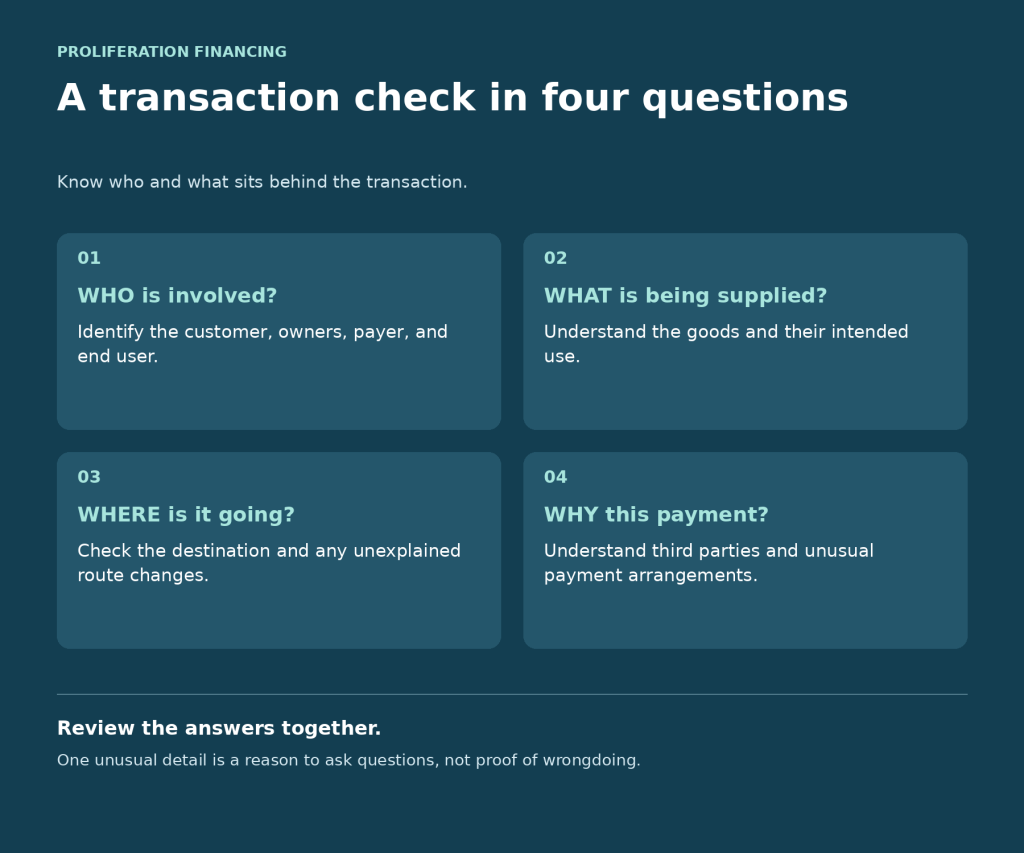
A transaction check in four questions
Proliferation Financing vs. Money Laundering and Terrorist Financing
These terms often appear together, but they describe different problems. This table simplifies the distinction.
| Term | Main concern | Helpful question |
| Money laundering | Hiding or disguising the criminal origin of money or assets. | Where did the money come from? |
| Terrorist financing | Providing support for terrorists or terrorist activity. | Who or what will the funds support? |
| Proliferation financing | Supporting weapons of mass destruction programs and related activity. | Could this transaction support prohibited procurement or a weapons program? |
These questions overlap. For example, checking where money came from is still relevant when investigating possible proliferation financing. The comparison is a starting point, not a separate checklist for each risk.
Three Proliferation Financing Examples
The following scenarios are fictional illustrations. They show situations worth investigating, not confirmed crimes or real enforcement cases.
1. The buyer cannot explain the end use
A small trading company orders specialist equipment that does not fit its usual business. When asked who will use it and for what purpose, it provides vague answers.
What needs checking? The real end user, the equipment’s intended purpose, and whether the order fits the customer’s business. An unusual order alone does not establish proliferation financing.
2. An unrelated company offers to pay
A supplier agrees to sell goods to one company. Before payment, a different business offers to settle the invoice. The customer cannot explain the relationship.
What needs checking? Who the payer is, why it is involved, and whether the supporting documents tell a consistent story.
3. The paperwork gives conflicting destinations
The purchase order names one destination, while shipping documents name another. The customer then requests another change without a clear commercial reason.
What needs checking? The final destination and the parties receiving the goods. If the contradictions remain unresolved, the transaction needs further review under the business’s procedures.
Proliferation Financing Red Flags to Watch for
The UAE Central Bank publishes risk indicators covering customers, transactions, and trade finance. The table below turns selected indicators into practical questions.
| Red flag | Question to ask |
| The customer gives incomplete information about its activities. | Can we verify what the business does? |
| The goods do not fit the customer’s stated business. | Why does this customer need these goods? |
| The end user’s business does not fit the purchase. | Does the stated use stand up to review? |
| Names, addresses, or destinations differ across documents. | What explains each inconsistency? |
| Payment instructions introduce an unexpected party. | Who is this party, and why are they involved? |
| Documents appear altered without explanation. | Can we obtain and verify reliable records? |
A red flag is a warning sign, not a verdict. Consider the whole transaction and document how you resolved the concern. A plausible explanation still needs evidence.
What should UAE Businesses do about the Risk?
Start by understanding your exposure. A proliferation financing risk assessment should consider how your customers, services, transactions, and business relationships could be misused.
The Financial Action Task Force, or FATF, calls for identifying and assessing risks involving breaches, evasion, or failure to implement proliferation-related targeted financial sanctions, then taking measures proportionate to those risks.
For a practical internal review, ask:
- Do staff know which concerns to raise and who should review them?
- Do our customer checks establish ownership and the purpose of the relationship?
- Can we explain unusual payers, shipping arrangements, and changes?
- Do our procedures address sanctions screening and unresolved alerts?
- Can we show the evidence behind our decisions?
These questions help expose gaps; they do not replace the requirements that apply to your business. UAE Central Bank guidance cited here is directed at licensed financial institutions. Other businesses need to check their own supervisor’s requirements.
What Should you do if Something Looks Wrong?
Raise the concern with your compliance officer or designated reviewer. Keep the relevant documents and a record of what does not add up.
Let the responsible team determine any required action, including sanctions measures and reporting, under the applicable rules. A possible sanctions match needs its own prescribed handling; it should not be treated as an ordinary request for more paperwork. Avoid alerting a customer to a possible suspicious transaction report.
Quick check: A buyer says, “The end user is confidential, but we can pay today.” Would your team know how to respond? Use this scenario to test whether staff know when to escalate an unanswered question.
Know what Sits Behind the Transaction
When an order, payment, or shipping instruction does not make sense, ask for an explanation and check the evidence. Make sure staff have someone to turn to when the answer is incomplete.
Need help reviewing your business’s exposure? Contact Vertex Compliance to discuss your compliance needs.
Frequently Asked Questions
What is proliferation financing in simple words?
It is financial or economic support for the spread of weapons of mass destruction, including related materials and delivery systems. That support can involve transactions that look like ordinary trade.
Are dual-use goods illegal?
No. They can have legitimate uses. Restrictions depend on the goods and the rules governing the parties, destination, and intended use.
What is counter proliferation financing?
Counter proliferation financing, often shortened to CPF, means measures to prevent and disrupt this support. Risk assessment and implementation of applicable targeted financial sanctions are central parts of that work.
Does a clean sanctions screening result remove all risk?
No. Screening is one control. You still need to understand the customer and transaction, including ownership, purpose, and unexplained inconsistencies.